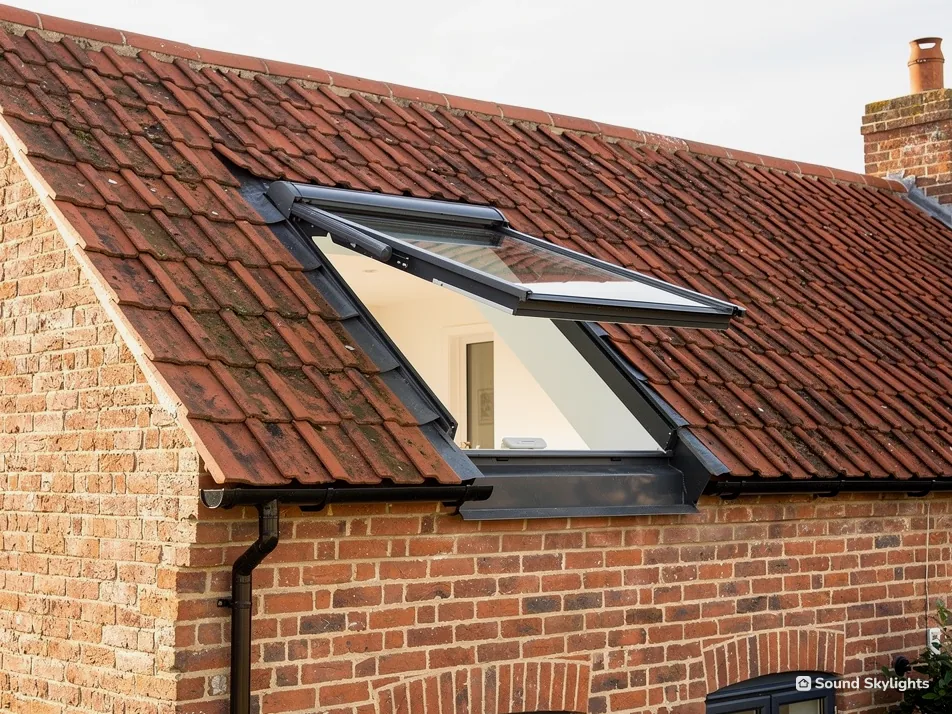

How will anyone reach a roof window set high in a large period house?
Knutsford's larger period houses, Legh Road designed by Richard Harding Watt among them, bring big rooms, and a roof window in the room above can sit well out of reach. A window you cannot touch is a window you stop using, so the way it opens is worth settling before the size.
Match the opening to the habit
A manual window can be opened with a telescopic rod from the floor. That suits a landing or a box room where you open it now and then. If the window is in a bedroom or a study and gets used every day, a motor makes more sense. Electric windows are wired in, which is easiest when the ceiling is already open for other work. Solar ones carry their own power, which suits a swap where you would rather leave the plaster alone. Our guide to electric and solar opening sets the two side by side.
Think about the blind at the same moment
Out of reach, a blind simply stays where it is. On a high window, choose one that works from the same remote as the motor, or from the same rod. Blackout suits a bedroom, while a stairwell window often needs nothing at all. The choices are laid out in our blinds and controls guide.
Who is in the house
Ask who will use the room. A teenager's bedroom, an older relative's room and a spare room that is rarely opened each end up with a different answer, even under one roof. Where children are about, a restrictor matters too, and the child-safe opening guide explains what is available.
Choosing how a high window opens
- Opened now and then
- A manual window and a rod from the floor
- Used every day
- An electric or solar motor
- Cable or no cable
- Electric is easiest while the ceiling is open; solar needs none
- The blind
- Worked from the same remote or rod as the window
- Children in the house
- A restrictor or a child-safe setting, agreed at survey