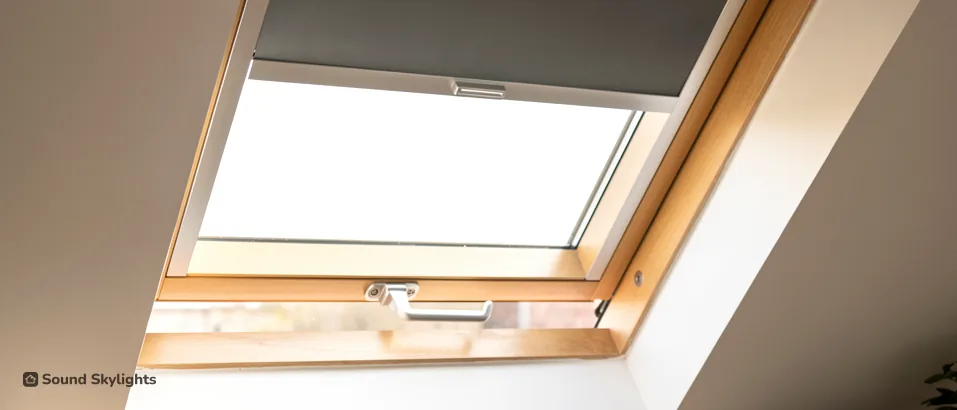
Two people can choose the same size of roof window and live with it very differently, because one opens by pivoting around its middle and the other swings out from a hinge along its top edge. The handle lands in a different place, the sash moves through a different part of the room, and the outer pane is cleaned in a different way. None of that shows in a catalogue photograph, and all of it shows up the first wet Tuesday you try to shut it.
This guide compares the two opening types by daily use: who opens the window, how high the handle sits, what stands underneath, how the glass is cleaned, how the blind behaves and where a top-hung window can help in a loft room. If you are still deciding on the product itself, our roof windows page covers the whole range, and a rooflight or skylight set into a pitched roof can open in one of these two ways, though some makers offer other styles too.
Begin with whoever opens it
The question that settles most of this is a plain one: who will be reaching for the handle, and from where? A tall adult on a landing, a ten-year-old in a bedroom and an older relative in a bathroom under the eaves each need something different.
A centre-pivot sash turns around a bar across its middle. The handle sits on the top edge, so to open it you reach up to the highest point of the window and pull the bar towards you. A top-hung sash is hinged at the top and swings outward from the bottom, so the handle sits along the lower edge. That is a long way from the top of a tall window, and a short way from a low one.
Neither is the better opening. A window placed low down the slope suits a top-hung handle, because the lower edge is at chest height. A window placed up near the ridge of a tall room suits a pivot only if the handle can be reached, which is a question about the ceiling and the floor, not about the window.
If the handle cannot be reached comfortably, the options are a control rod hooked onto it, a motor driven from the wall or a handset, or a different spot in the slope for the window. We raise this at the survey, standing in the room, because a handle that is awkward on the day of the survey will be awkward every day after it.
Think too about the season. In summer you may want a window open most of the day, so the handle is used often and a stiff or awkward one gets old quickly. In winter it stays shut for weeks. Choose for the busy months, since that is when the handle is used.
The two types, side by side
The table sets out what changes in daily use. Models differ between makers, so treat it as a guide to what to ask about rather than a promise for every window.
| Question | Centre-pivot | Top-hung |
|---|---|---|
| Handle | Top edge of the sash | Bottom edge of the sash |
| What moves | Sash turns around its middle | Sash swings out from the bottom |
| Outer pane | Turns round to face the room | Depends on the model |
| Best for | Reaching the glass from indoors | Low windows, wider gap on some models |
What can stand underneath
A window in the slope sits above whatever is below it, and the sash does not stay in the plane of the roof when it opens. On a centre-pivot, the upper part of the sash comes into the room while the lower part goes out, so a tall wardrobe, a high shelf or a person standing under the upper part of the window can be in its way. The sash can also bring the glass close to a person standing at the foot of a bed or at a basin.
A top-hung sash swings outward and upward, which leaves the room clear. Its price is that the sash stands out from the roof when open, and the handle at the bottom edge ends up where a table or a cot may be.
Children and older relatives matter here as well. A sash that swings low over a bed or a basin is something a small person can walk into, and a handle at floor-reach height on a top-hung window is within a toddler's grasp. Households with small children can ask about restrictors, which some makers offer on certain models, and a handset can be parked up on a shelf. Raise both at the survey; neither is a guarantee of safety.
Standing in the room with a tape measure answers this better than a drawing. Mark where the sash edge will pass and note what is below.
Look under the window for
- A wardrobe, bookcase or shelf that rises towards the window frame
- The head of a bed, a cot or a desk with a monitor
- A radiator, basin or worktop that the handle would have to reach over
- A blind cord or pole that needs a free hand's width beside the frame
Cleaning the outer pane from indoors
Pitched roofs are not places to stand with a bucket. The centre-pivot has a real advantage here: it turns far enough for the outer pane to face the room, so a cloth and a spray bottle do the job without a ladder. Some makers fit a stop or a catch so that the sash holds in that position.
On a top-hung window the outer glass faces the sky even with the sash open, and the answer depends on the model. Some makers describe a top-hung sash that can be released for cleaning, others expect the glass to be reached from outside. We find out which applies before the order goes in, and the handover includes showing you how the outer glass of your window is cleaned. The walk-through is part of what we explain before we leave, so the first clean is not a guess.
Makers also offer self-cleaning or easy-clean coatings on some glass. The maker says these help rain carry dirt away, and they do not replace a cloth on the inside of a pivoting sash. Our living with a rooflight page covers keeping the glass clear across the year.
If you cannot clean the outer pane yourself, you will not.
Rods, motors and the sash you choose
Opening type and opening method are separate decisions, and they interact. A control rod hooks onto a handle, so it suits the handle position of whichever type you pick: on a top-hung window the handle is low, so a rod may not be needed, while on a centre-pivot placed up near the ridge of a tall room the rod does the reaching.
Some makers also build motorised versions, though not of every type or model. The motor takes the place of the handle, and it answers to a push-button on the wall or a handset. A rain-triggered sensor that closes the sash is an extra with some makers, and some use a small solar panel instead of a mains cable. Not every model carries these extras, so the type you like can narrow the choice, and the maker's range is checked before the quote is written.
Wiring is easiest to plan early, since a cable needs a route to the window before the lining is closed in. Our electric opening rooflights page explains the options in more detail.
Blinds and the moving sash
Blinds are made for a particular maker's frame and a particular size code, so a blind fits its own window and not a lookalike. A blind of this kind can run in side channels on the window, and how it behaves as the sash moves varies by maker and model.
The difference shows in use. On a centre-pivot the blind is on the room side, so ask how it should be set before the sash is turned to clean the outer pane. On a top-hung window the handle sits at the lower edge, close to where a drawn blind ends, so ask how the two work together on the model you choose.
The room decides the fabric. Blackout suits a bedroom, a softer fabric suits a kitchen or office, and a damp-room blind is the one made for a bathroom. At handover the blind and its cord or pole are explained, and the guide to VELUX blinds and controls goes through the fabrics room by room.
Where a top-hung window helps with escape
In a loft room that is also a bedroom, the window may have to double as the way out, and this is where the two types separate most. A centre-pivot sash opens around a bar across its middle, which leaves two narrower gaps, one above the pivot and one below. A top-hung sash swings out of the way from its lower edge, and on some models the open sash leaves a single, wider clear gap.
That wider gap is why some loft rooms pair one top-hung window with centre-pivot windows elsewhere. Which model qualifies depends on the maker's data for the window and on the size of the clear opening, which the Building Regulations guidance sets out. Those figures, and the limits on where a window can serve as a route out at all, are on our building regulations guide. The same choice seen from the loft room is in our guide to loft conversion roof windows.
Which window is the escape window is for your designer or building control to say; we then match the size code and the style of opening to it.
How the choice gets made at the survey
You do not need to settle this alone. The free survey covers the points above in the room itself, and the price follows afterwards as a fixed written quote.
Photos of the room and the roof can go to WhatsApp 07880 284133 as a first look, but the price waits for the survey.
From question to fitted window
- Who uses it. We ask who opens the window, the room's purpose and who else lives there.
- Stand in the room. We check the handle height, what is underneath and where the sash would swing.
- Pick the type. Centre-pivot, top-hung or a mix, with a rod or motor where the handle is out of reach.
- Fixed written quote. It follows the survey. Whichever of the two we fit, the fitting work gets the 10-year workmanship guarantee.
Want this looked at on your own roof?
- Fixed written quote
- We handle the Building Regulations notification where the work is notifiable
- 10-year workmanship guarantee