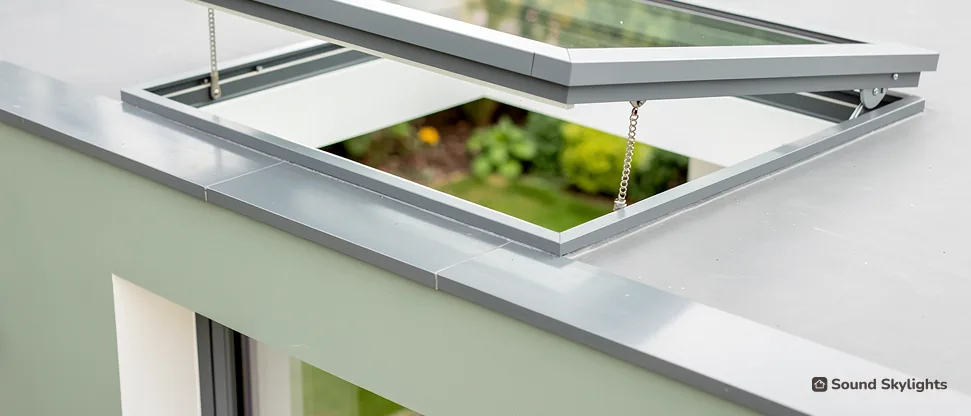
Anyone who opens a window on a bright morning can come home to a grey afternoon. With a skylight overhead the worry is sharper, because the opening faces the sky. A rain sensor is one answer some makers offer: a small detector that tells an electric or solar window to close when it feels water.
It is a useful feature and a limited one. It is fitted by some makers on some models, it does not suit every roof or household, and it never replaces a habit. This page explains the feature plainly so you can ask the right questions of a maker. If you want the whole subject of motorised windows first, start with our overview of electric opening rooflights.
The wet windowsill problem
A manual rooflight left ajar in a shower is a minor annoyance if you are in the house and a bigger one if you are out for the day. Rain on the glass does no harm; rain coming past the frame onto a worktop, a bed or a carpet is the trouble. A sensor earns its place where the unit sits over a surface you care about.
Every opening rooflight shares the situation, be it a roof window on a slope, a hinged unit on a flat roof or a vent pane in a lantern. What differs is how much opens and how fast the glass can close. A wide gap lets in more than a narrow one, and a gap over a kitchen table matters more than one over an empty landing.
A sensor does one job, and one only: it responds to water on the unit. Read what the maker says about the rest of the behaviour, and treat anything beyond that as unconfirmed until the instructions say it.
A sensor watches for water on the glass; it cannot see your washing, your bed or the weather coming.
What the sensor does when the first drops land
The makers describe the sensor as a compact detector mounted on the sash or its frame. Once water reaches it, a signal goes to the motor, which closes the window. Nobody has to press anything.
That is all it does, and the details come from the maker rather than from us. How quickly it reacts, how much water it needs to feel, whether the window then stays shut once the rain stops, and whether the sensor can be switched off are all things the individual model's instructions will answer. It is wise to ask for them before buying, since a window that reopens by itself after a shower suits some households and not others.
It is also worth noticing what the sensor cannot do. It has no way to tell you that rain is forecast, and it does nothing about a vent propped open with a stay on a model without a motor. Whether one sensor can close more than one window depends on the maker's system, so a pair of rooflights over one table is a case to ask about.
Which makers fit one, and on which models
Rain sensors are not a universal part of opening rooflights. VELUX lists a sensor on the INTEGRA electric and solar roof windows it makes, one it says closes the window the moment it senses rain. Elsewhere, makers have their own versions for certain electric and solar units, and some sell the sensor separately. Some flat rooflights and lantern vents have none at all.
So the useful habit is to go product by product. The same maker can make a sensor available on one window and not on the next one down the range, and a handset or controller sold with one range may not work another maker's motor. We read the specification for the unit you are considering rather than repeating a general claim.
The table below sets out the question for each family of product, since the answer differs by type and by maker.
| Product | Opening method | Ask the maker |
|---|---|---|
| Pitched roof window | Electric or solar, from some makers | Is the sensor built in or an extra? |
| Flat rooflight | Glass moved by an actuator | Which models take a sensor? |
| Roof lantern | Vent pane on some lanterns | Is a sensor offered for it? |
| Manual window | Handle or control rod | No motor, so none |
What a sensor leaves with you
Even where a model has a sensor, a few jobs stay with the household. The first is the window with no sensor in the house at all: a manual rooflight, a second unit, a vent in a lantern. If you have a mixed set, the habit has to cover the whole set.
The second is the sensor itself. The detector is mounted on the sash or its frame, where leaf litter, dust and bird mess can settle, so it gets wiped whenever the outer glass is cleaned. A covered sensor may not feel rain, and the maker's instructions give any further care.
The third is power. A mains unit with the supply off, or a solar one with a flat battery, may not be able to close itself, however wet the sensor is. Ask the maker what the model does then, and keep the remote in a known place so you can act yourself.
The fourth is plain: the sensor reacts to rain and is no judge of when you want the room closed. If you are leaving the house, closing the rooflight is still a habit worth keeping.
Jobs a sensor does not take over
- Closing manual windows and any unit without a sensor
- Wiping the sensor clear when the glass is cleaned
- Knowing what the unit does if the supply or battery fails
- Shutting the glass when you go out, as a habit
- Telling the maker if it stops responding
How it fits a family's week
Picture a kitchen with an opening rooflight over the worktop. The glass is raised while the pasta boils. Somebody walks out to the school gate and the glass stays up. With a sensor on that unit, the first drops close it. Without one, the glass stays up until somebody gets home.
A loft bedroom is a different case. The person who opens the window may be a teenager who forgets, and the bed sits right below it. A sensor is a reasonable thing to want here, and the blind and the bed position are worth discussing at the same time.
In a shared house, or one where an older relative is at home on their own for part of the day, it can be useful to agree who closes the glass last and to keep the remote in one place. A sensor then becomes a second line of defence, with the first being a settled routine.
None of this needs any extra thought on a dry day, and on a wet one it saves a wet sill. A household with a child's bedroom under the slope may weigh it differently from a couple with a spare room, and that is why we ask about the people before the product. A sensor is easiest to plan before the order goes in, because the model is chosen at that point. At handover, the opening, the closing and the position of each control are demonstrated on your own unit.
Opening a little, and watching a changeable sky
Rain sensors sit alongside another sensible habit, which is to open the glass by the amount the day needs. A small gap can let steam leave a kitchen while letting in less water than a wide one, and some units can be stopped part way along their travel with the handset or the switch. Whether a particular model does that is something to confirm with the maker.
Changeable weather is when the habit matters. On a bright, unsettled day the glass can be left a hand's width open, and on a plainly wet one it stays shut. If the model has a sensor, it is a second check on the first decision and not a reason to stop making it.
The same thinking applies to the shape of the room beneath. A rooflight over a hard floor or a tiled worktop forgives a few drops. One over a sofa, a bed or a piano does not, and for those places a sensor is a stronger reason to choose a motorised unit than for a utility room.
Keeping it clear and noticing when it stops
The care is light. Wipe the sensor along with the outer glass, using only what the maker says is safe for it. Solvents and polish do not belong on seals or on the control box. For a flat unit, the outer face is washed from the garden with a pole fed by water, or standing on a ladder at the edge of the roof. Do not stand on an opening rooflight, as only walk-on units are built for a person's weight.
A centre-pivot roof window can be swung round until the outside glass is facing you, for cleaning; the maker's manual says how to reach the sensor itself.
A window that stays open through a shower is telling you something. A sensor that fails to respond has stopped doing its job, so report it to the maker, whose manual may list what to check first. Testing it now and then, as the instructions allow, means a fault turns up on a dry day.
Choosing one at the survey
The visit costs nothing, and a figure only appears once the roof and the room have been seen. We look at the controls as well, and talk about who opens the glass and whether a sensor is wanted on that unit. Then the choice is checked against the maker's data for the models that can be fitted, including whether the sensor is a built-in part or something added to the order, and whether the blind you want can sit under the open glass. How a sensor shows up in the price is covered by the electric rooflight cost answer, and keeping a remote out of small hands is picked up in the page on children's rooms.
Settling the sensor question
- Say who opens it. The person, the room and the hours it stays open.
- Check the model. Whether a sensor is built in, optional, or absent.
- Check the power. Mains or solar, and what happens when it fails.
- Price it after the survey. It comes as a fixed written quote once the choice is made.
- Try it at handover. You see the glass open and close before we leave.
Want this looked at on your own roof?
- Fixed written quote
- We handle the Building Regulations notification where the work is notifiable
- 10-year workmanship guarantee