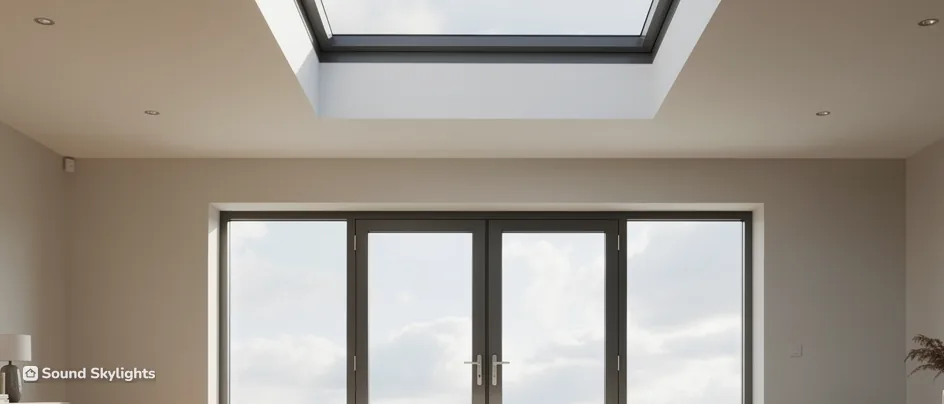
A south-facing extension is lovely at ten in the morning. By three in the afternoon, with the sun full on the glass above the table, it can be a different room. People retreat to the shady end, the blind goes across, a vent gets propped open, and the whole point of the glass is quietly forgotten. Solar control glass is one answer to that afternoon, and it is worth understanding before you order, because it changes the glass on the dull days of the year as well as the hot ones.
This guide starts with how it is lived with, then goes into how a coating works, what it costs in light, and when a blind or a vent does the job better. It belongs with our energy-efficient rooflights page, and the words rooflight and skylight mean the same thing here.
A bright afternoon under the glass
Start with what actually happens in the room. Sun strikes the glass, passes through, and lands on the floor, the table and the people. Those surfaces warm up and give the heat back to the air. A pale floor sends some of it back out through the glass; a dark one holds on to it.
The daily controls are few. Someone draws a blind. Someone opens the rooflight, where it opens, so the warm air above can leave. Someone closes it again when it rains. A room that depends on all three every sunny day is working hard for its occupants, and that is the situation solar control glass is meant to ease.
Who is at home matters. A kitchen with someone in it all day has a person on hand to adjust things. A rear extension that stands empty until the evening has no one to draw a blind at noon, and it heats up unattended. A home office with a screen under a rooflight has a glare problem as well as a heat one.
Notice these on the next sunny day
- What time the sun first reaches the glass, and when it leaves
- Whether the heat is on you, on the table or on the floor
- Who is in the room at that hour, and who would draw a blind
- Whether the screen or the page is hard to read
- How far the rooflight opens, and who can reach it
How a coating cuts the heat
Solar control glass usually carries a very thin coating, typically on one of the faces within the sealed unit. The coating is built to turn back or absorb part of the sun's energy before it reaches the room, while letting a good share of the visible light through. Some makers get a similar result with a tinted pane, where the colour is in the glass itself.
Two numbers describe the result, and they answer different questions. The U-value, explained in rooflight U-values and Part L, says how much warmth the unit holds in. A second figure, usually the solar factor or g-value, says how much of the sun's energy gets through. A low solar factor keeps the room cooler on a sunny day. A low U-value keeps it warmer on a cold one. A good specification is chosen with both in view.
The coating does not make the room cold, and it does not stop the sun. It trims the sun's energy, and the room still brightens when the sun appears. The maker's data sheet should give the figures for the exact glazing you are being offered, not for a sister product.
What it costs you in daylight
Nothing in glass comes free. A coating that turns back more of the sun's energy also tends to turn back some visible light, so the room can be slightly dimmer than under clear glass. A tinted pane does the same more visibly. You see the difference rather than measure it, which is why a sample is worth holding up.
There is a second effect on how the glass looks. Some coatings have a faint tone, or a reflective sheen from certain angles, and the glass can look different from the garden than it does from the room. Asking for a sample pane and looking at it against the sky and against your wall colour settles the matter faster than any description.
Where a room is already short of light, the trade deserves more thought. A dark landing under a roof window may gain nothing from solar control and lose something, if the sun on the glass is not the problem. In a bright south-facing kitchen, a small loss of light may hardly be noticed and the comfort gain can be plain.
| Room and aspect | What you want | Direction to lean |
|---|---|---|
| South or west kitchen extension | Less afternoon heat, light kept | Solar control glass and a blind |
| North-facing room | Every scrap of light | Clear glass |
| Home office | Less glare on a screen | Solar control, or a softer blind |
| Dark landing or hall | More daylight | Clear glass |
South-facing extensions and the rooms that benefit
Aspect decides most of it. A roof window on a north-facing slope sees even, indirect light and rarely brings in more heat than the room can lose. A south or west aspect puts the sun squarely on the glass for hours. On a flat roof, the glass is nearly horizontal, which lets the high summer sun straight in, so glass set flat in a rear extension's roof can warm a room faster than the same area of window in a wall.
Take a rear addition to an interwar semi or bungalow in Bramhall, Cheadle Hulme, Hazel Grove or Heald Green, with a lantern over the table. The same thought applies to a loft room under a Victorian villa's roof in the Heatons or Davenport, where the glass sits close to the sleeping or working space and a roof window facing the afternoon sun can leave the room stuffy.
Size and shape also change the equation. A large lantern puts a lot of glass over a small floor, and the more glass, the more choice of coating matters. A pair of smaller rooflights on a shaded slope may need no coating at all. Our roof lanterns page looks at how the shape is chosen.
When a blind does the job better
A coating works all the time, in every season. That is its strength on a hot day and its cost on a dull one: it trims a little of the free warmth the winter sun would give, and it trims a little of the light on a grey day. A blind can be drawn when it is needed and left open when it is not, so it matches the weather instead of a fixed average.
Where the room is mainly in use before noon, or one where the sun reaches the glass for only a short spell, a blind can be the simpler and more flexible answer. A coating earns its place where the sun is on the glass through most of the day, or where nobody is home to adjust anything, and a blind then handles the extreme days.
Blinds are matched to the room: blackout for bedrooms, a softer fabric for kitchens and offices, and damp-room blinds for bathrooms. Each blind is matched to the code and maker stamped on the window, so it is easier to settle alongside the unit. Electric and solar-powered blinds are options from some makers, and a few supply blinds fitted outside, which stop heat before it reaches the glass. Which of those suits a particular model is a question for the survey.
A coating works every day. A blind works the days you ask it to.
Opening, shading and cleaning through the year
Whatever glass is chosen, the rooflight is part of a routine. Manual units are opened by hand, control-rod units by a pole from the floor, and electric units by a wall switch or a remote. Where the glass is high, the choice of opening method decides whether the vent gets used at all on a hot afternoon. A vent that nobody can reach does nothing.
Some makers say their glass has a coating that helps the outside shed dirt, or a rain sensor that closes an electric unit when rain starts. Those are the makers' features, found on certain models only, and worth asking about for the model you are considering. They do not replace cleaning.
Cleaning depends on the unit. With a centre-pivot model, the sash swings round and brings the outer face into the room for wiping. Flat rooflights and lanterns are washed from outside, with a pole that feeds water to the brush or a ladder at the roof edge. Treading on the glass is only for walk-on units. A coated surface should be cleaned the way the maker describes, so ask for that at handover.
From question to glass on the roof
- The survey Aspect, room use, ceiling height and who opens the unit are looked at on site. No price is set until the free survey is done.
- The glass choice Clear, solar control or tinted glass is matched to the room, while the blind and the way it opens are weighed alongside.
- The fixed written quote The price follows once the glass is agreed, set out in writing.
- Handover Handover is a walk-through of the opener, the blinds and the washing of the outer glass.
Regulations, price and the finished unit
A unit with solar control glass still has to be a well-insulated one. Solar control glass leaves the England yardsticks where they are: 2.2 W/m²K for a rooflight, and for a roof window 1.4 W/m²K with Band B as the alternative route. The glazing choice sits inside those figures rather than outside them.
On price, solar control glass is one of the items that moves a quote, alongside size, frame and the kerb, and what moves the price of an efficient rooflight sets out the rest. A third pane is a separate decision, and triple glazed rooflights compares it with double.
For this kind of unit, where the work is notifiable, we handle the Building Regulations notification with the council's building control team or a registered building control approver. Once a solar control unit is in, our workmanship on it is guaranteed for 10 years, in writing. The rooflight that comes out of all this is judged less by its data sheet than by a hot Thursday in July, so the best test is to describe that day at the survey.
Want this looked at on your own roof?
- Fixed written quote
- We handle the Building Regulations notification where the work is notifiable
- 10-year workmanship guarantee