Daylight for rooms with no window

Sun tunnels in Stockport

A roof dome, a mirrored tube and a ceiling diffuser light the landing, hall or bathroom that has no window of its own.

Takes you to the survey form on this page and adds your postcode to any WhatsApp message.

  • Fixed written quote
  • We handle the Building Regulations notification where the work is notifiable
  • 10-year workmanship guarantee
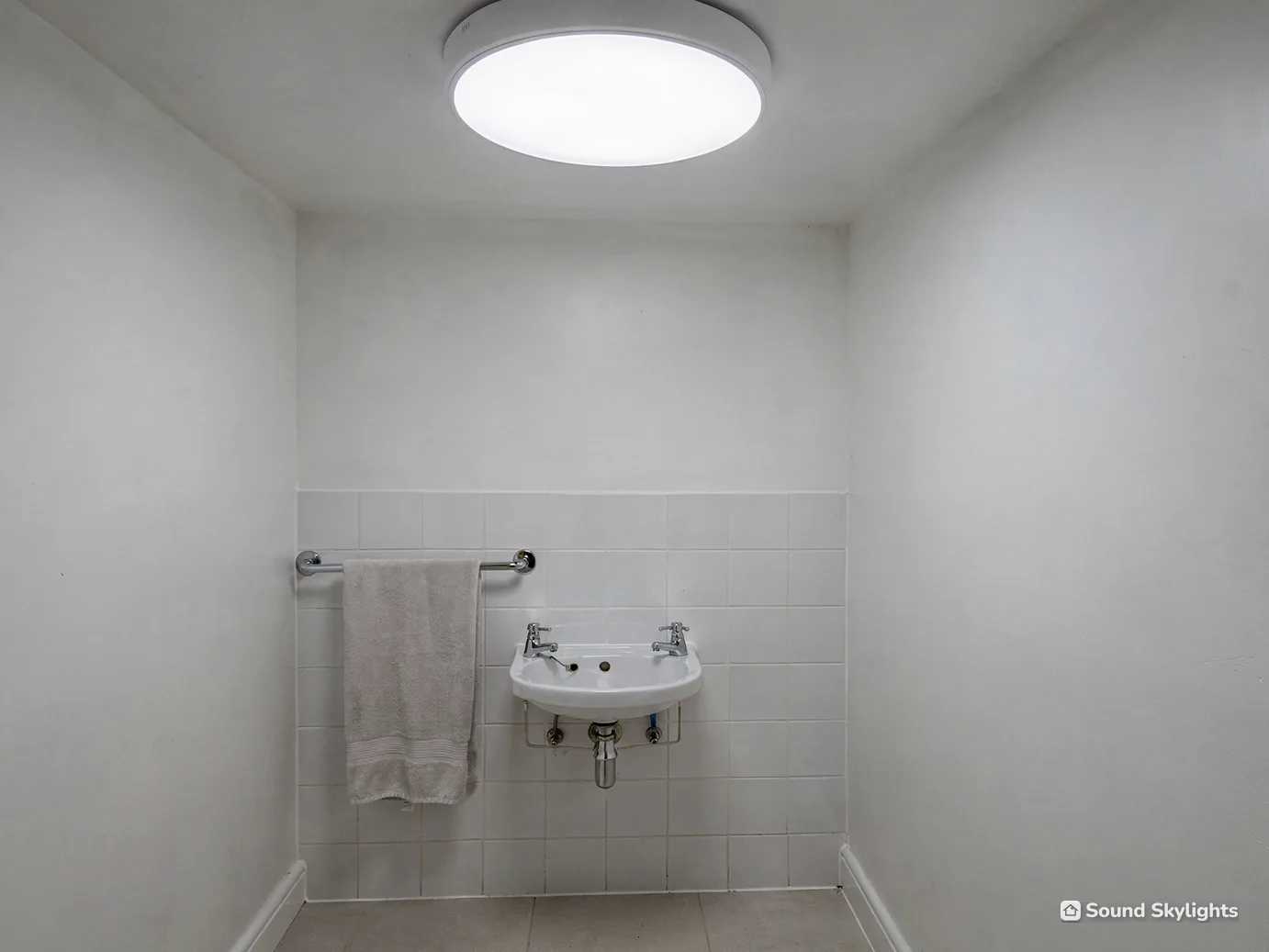
A windowless cloakroom lit by the round diffuser of a sun tunnel

A sun tunnel, sometimes called a light tube, has a dome on the roof that collects daylight. A reflective tube then leads it to the ceiling, where a round diffuser spreads it through the room. It suits a room with no outside wall for a window: a landing, an inner hall, a cloakroom, a bathroom. We fit them in tiled, slate and flat roofs on houses around Stockport and its neighbouring towns.

It starts with a free survey, because the length and route of the tube shape the choice of unit, and a fixed written quote comes afterwards. If you are still comparing products, our overview of skylight and rooflight installation in Stockport sets the sun tunnel beside the rest.

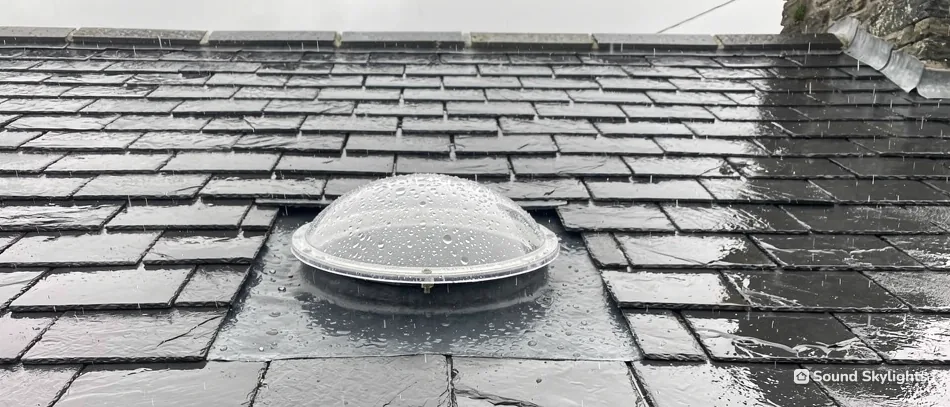
A sun tunnel dome on a wet slate roof

Wiping the diffuser, washing the dome

  • No handle, no switch: daylight comes down the tube whenever there is some, and the room's own light fitting covers the evenings.
  • The diffuser is wiped from inside the room. The dome on the roof is cleaned from outside, and the method is explained at handover.
  • The tube is routed at the survey, because a tall ceiling, a loft floor or a beam can send it a different way.
  • Fitting the dome, tube and diffuser is work we stand behind with our 10-year workmanship guarantee, a document you keep.

Light tubes

Routing, fitting and caring for a sun tunnel in an older house

How the tube works, which rooms suit it, rigid or flexible, how a fitting goes and what the council needs to hear.

Light travels down a sun tunnel by reflection, and every metre of tube and every bend takes a little of it away. That one fact shapes the questions below: which rooms can be reached, which tube suits the roof space, and when a window is the better answer.

What is a sun tunnel, and how does daylight get down the tube?

Dome, flashing, tube and diffuser

At the top is a clear dome, in acrylic or polycarbonate depending on the maker, that sits on a base fixed to the roof. A flashing or collar seals the base to the roof covering, so the joint is watertight. Below the dome is the tube, which runs down through the roof space. At the bottom is the diffuser, a frosted disc set into the ceiling that scatters the light into the room.

A hallway with a sun tunnel diffuser and a flat rooflight in the ceiling

Why the tube is mirrored

The inside of the tube is reflective, so light bounces down it instead of being absorbed. A longer or bendier tube loses more along the way, which is why a flat, short run gives the brightest result. Makers say so in their literature, and the route is chosen with that in mind.

Sizes and makers

Several makers sell sun tunnels, and each has its own range of tube widths, dome styles and diffusers. A wider tube carries more light, and a narrower one fits a tighter roof space. Tube lengths come from the maker's stock and are cut to suit each house. Where a roof or ceiling is an odd shape, a bespoke adaptor or collar may be needed, and the maker's range shows what is available.

What you see and what you do not

You see a round, soft patch of daylight in the ceiling. You do not get a view of the sky, and you cannot open it, which makes it a different product from a roof window.

Warmth and energy efficiency

A sun tunnel passes through the roof build-up, so it is a place where heat could escape if it were badly fitted. Makers publish their own performance figures for the dome, the tube and the diffuser, and we read them with you. The insulation round the tube is put back after the fitting, and the diffuser sits tight to the ceiling. Approved Document L sets U-value limits for roof windows and rooflights but does not name sun tunnels, so the figures we look at are the maker's own.

Names for the same thing

Light tube, sun pipe, sun tube and sun tunnel all mean the same product. We use sun tunnel for it and rooflight for the glazed units that sit on kerbs or in the slope, which are a different family. VELUX and several other makers each have a sun tunnel range.

Sun tunnel parts

Dome
The clear cap up on the roof, catching daylight.
Flashing
The sealed collar that joins the dome's base to the roof covering.
Tube
The mirrored pipe that carries the light down.
Diffuser
The frosted disc set flush in the ceiling, spreading light into the room.
Run
The path the tube takes from roof to ceiling.
Which windowless rooms is a sun tunnel good for?

Rooms and sun tunnels
RoomWhy it can suitWatch for
LandingShort run, brightens stairsLoft rooms overhead
BathroomDaylight with no outside wallStill needs its own extract
CloakroomSmall, no windowRun through other rooms
Utility roomDark inner roomLength of tube
BedroomDaylight onlyNo fitted blind, so hard to darken

Landings and inner halls

Many interwar and post-war semis in Hazel Grove, Bramhall and Cheadle Hulme have a dark landing, and an inner hall can lack a window altogether. A sun tunnel puts daylight into the middle of the house, and the stairs are brighter for it. A landing under a pitched roof can suit one especially well, because the run can be short and straight.

Bathrooms, cloakrooms and utility rooms

A bathroom with no outside wall is a good case. So is a ground-floor cloakroom under the stairs or a utility room in the middle of a plan. The sun tunnel brings daylight, but it does not bring ventilation: a bathroom still has its extractor or its own window to deal with steam. Which rooms suit a sun tunnel gives room-by-room advice.

Kitchens, wardrobes and corridors

A galley kitchen at the centre of an extension, a walk-in wardrobe and a long corridor are all candidates. A bedroom is a poorer fit, because a bedroom wants to be darkened as easily as lit and a sun tunnel takes no fitted blind of the kind a roof window does, though some makers offer a dimmer as an extra. A roof window with a blackout blind is a better fit there.

Roofs and ceilings around Stockport

Villas in the Heatons and Davenport, Victorian and Edwardian, have long drops from a high roof to a ground-floor hall, so the tube is long, and we weigh that against a roof lantern or a rooflight on the stairwell. A red-brick terrace in Reddish or Edgeley with a back addition can have a dark middle room under a low roof that suits a short run. Houses of stone and brick around Marple, Romiley and High Lane can have deep walls and beams, which is where a flexible length can help.

Where a sun tunnel does not work

The room has to sit under the roof, or the tube has to be able to reach it. A room beneath a floored loft conversion has the loft rooms in the way, so it cannot take a sun tunnel unless the tube can run beside them. If a room has a flat roof above it, an opening or fixed flat rooflight may do more, as our flat roof rooflights page explains.

Would a window in the roof do the job better than a sun tunnel?

If you want to see the sky, or to open the glass, a sun tunnel is the wrong tool. A roof window set into a sloping roof gives both. A VELUX or other maker's window can be electric or solar, opened with a rod, or left fixed, and it takes a blind. A flat rooflight does the same on a flat roof.

Where the room is under the roof

A loft conversion has a sloping ceiling that suits roof windows and not tubes, since there is no roof space for a tube to cross. A bedroom in the loft is a roof window job. For a deep kitchen extension, a roof lantern serves the floor well, as does a flat rooflight, since both spread more light across a wider floor. An orangery or conservatory roof is a lantern or glazed roof job. A sun tunnel can still help a small corner of an extension, such as a utility space behind the kitchen, that the main glazing does not reach.

Glass, glazing and the frame

A rooflight can be double or triple glazed, with an aluminium, uPVC or timber frame, and has a defined U-value. Nowhere does Approved Document L mention sun tunnels by name, so for one of those it is the maker's own figures we look at. If energy performance matters most, our energy-efficient rooflights page covers the glass options.

Replacing an old unit

If you have a misted skylight over a landing, you can replace it with a new sealed unit, with a different rooflight, or with a sun tunnel if all you want is daylight. Our misted rooflights page covers the first choice. If you need an opening window, a sun tunnel is not the replacement. The two also work together in some homes: roof windows in the loft rooms, a sun tunnel on the landing between them.

Sun tunnel or rooflight
NeedSun tunnelRoof window or rooflight
Daylight onlySuits itAlso works
A view of the skyNoYes
OpensNoCan, with a rod or a motor
Takes a fitted blindNoYes, sized to the window
Room under a floored loftRun may be blockedSuits the sloping ceiling

Rigid tube or flexible tube: which does my roof need?

Rigid tubes

A rigid tube is a hard, straight pipe with a mirrored finish, often joined in sections, that carries light well along a straight run. It suits a house where the dome sits directly above the diffuser, or where a short angled elbow gets round one obstacle. Makers say it gives the brightest result on a long straight drop. Because the pieces are cut to the run, the length has to be right, so the roof space is measured with care.

Flexible tubes

A flexible tube is a corrugated, reflective duct that bends. It goes round a beam, a chimney breast or a water tank, where a rigid tube cannot, and it can be curved to meet a diffuser that is not directly under the dome. The trade is that the ridges scatter more light than a smooth pipe, and every bend costs a little brightness. Makers give a limit on how many bends and how long a flexible tube should be.

Tall ceilings and long drops

The longer the tube, the more light it loses on the way. A high-ceilinged hall in a villa asks more of a tube than a low landing does, and a tube that is too long and winding can leave the diffuser dim. Makers publish guidance on how long and how many bends a given tube width can take, and we keep to it. If the run is too long for a good result, we say so and suggest a different product.

Mixing the two

Some jobs use both: a rigid section where the drop is straight and a short flexible length to take up the offset. The roof space settles the mix, and it is judged on the survey visit. The full comparison is in rigid or flexible sun tunnels.

Rigid against flexible

Shape of the run
Rigid: straight. Flexible: can curve round obstacles
Light carried
Rigid: smooth finish. Flexible: corrugations scatter some
Roof space
Rigid: needs clear room. Flexible: fits tighter spaces
Length
Rigid is cut to size. Flexible is stretched to suit
Our starting point
The shortest, straightest route the roof allows

What happens when the sun tunnel is fitted, and how long should I allow?

A sun tunnel is not priced from a photograph. The survey looks at the room, the roof and the roof space, checks the line from roof to ceiling, finds any obstacle in the way and measures the run. The diffuser's position follows the way the room is used.

The order of work on a pitched roof

  1. Survey the run. The room, the roof and the roof space are looked at, and the route from roof to ceiling is measured.
  2. Open the roof. The position is marked on the roof, the tiles or slates come off and the opening is formed between two rafters.
  3. Fit the base and flashing. The base is bedded into the covering so it is watertight.
  4. Fit the dome. It goes on the base once the flashing is in.
  5. Run the tube. Inside, the tube is taken down through the roof space, joined and supported, with the loft insulation put back around it.
  6. Fit the diffuser. The ceiling is cut and the diffuser sits flush, with the plasterwork round it finished.
  7. Show the cleaning. At handover you see the diffuser and the dome up close, how each is cleaned and what a shifted part looks like.

Slate, plain tile and profiled tile

The base of a sun tunnel on a pitched roof comes with a flashing that must suit the covering. A plain tile or slate roof takes a flashing that laps under and over the courses, while a profiled or interlocking tile has a flashing shaped to its ridges. The one from the maker's range that matches your roof is chosen and checked at survey, since a flashing that does not match the tiles is where a problem would start.

On a flat roof

A flat roof uses a base set on the deck or on a small upstand, with the roof covering lapped up to it. The dome clips on the top, and the tube and diffuser follow below. Our flat roof rooflights page covers what happens to a flat roof around an opening.

Dust, and how long it takes

Dust sheets go down in the room below before the ceiling is cut. The tube length, the roof type and the access all change the time, so it is judged after the survey; our page on sun tunnel fitting time sets out what lengthens or shortens the work.

Route and brightness

The shorter and straighter the route from roof to ceiling, the brighter the result.

What is it like to live with a sun tunnel, and how is it kept clean?

The light through the day

A sun tunnel gives soft, even daylight that follows the sky. On a bright day it is generous, and on a grey Stockport morning it gives less, because there is less to collect. The room still needs its ordinary light fitting for evenings and dull days.

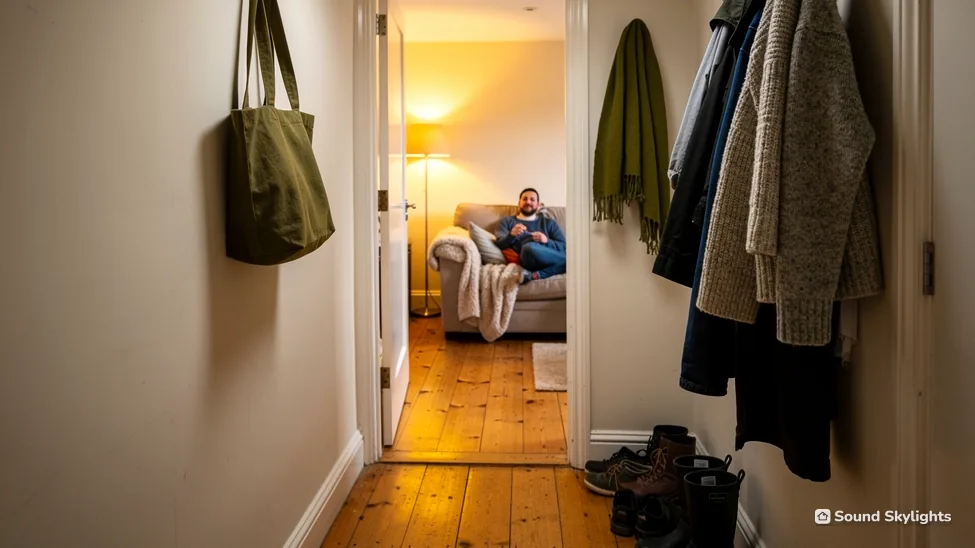
A hallway with coats on hooks and a sun tunnel light in the ceiling, the sitting room beyond

No handle, no blind

Nothing here opens and there is no fitted blind, though some makers sell a dimmer as an option. For a hallway or a landing that suits: it works without anyone doing anything. For a bedroom it is a limit, which is why bedrooms are steered towards a roof window and a blackout blind.

Cleaning and upkeep

Wipe the diffuser from inside with a soft cloth. The dome sits on the roof and is washed from outside, by a water-fed pole held at ground level, or from a ladder propped on the house wall, depending on pitch and height. Nobody needs to stand on the roof to do it. A dome in a leafy garden collects debris sooner than one in the open, so how often it needs washing follows the setting. There are no moving parts; keep gutters and nearby leaves clear of the dome, and glance at the flashing from time to time.

Upkeep of dome and diffuser

Maintenance amounts to a wipe of the diffuser and an occasional wash of the dome. At handover you are shown how each is cleaned and what a shifted part looks like, so a loose flashing or a dim diffuser is spotted early. Debris on the dome cuts the light it passes, and a damp cloth inside is all the diffuser needs.

Condensation and the tube

If a tube is routed through a cold roof space, moisture from the room below can meet cold surfaces. Where that is a risk, the fitting takes it into account, and ventilation in the room, such as a bathroom extractor, still needs to work. In a bathroom the daylight arrives while the extractor or the window handles the steam.

What do the planning and Building Regulations rules say about a sun tunnel?

Planning

A sun tunnel counts as an alteration to the roof, and Class C permitted development usually lets a homeowner in England make that kind of alteration, for example by adding a rooflight, within set limits. Its dome stands proud of the roof, so at survey its height is checked against the limit on protrusion beyond the plane of the original roof slope, measured at right angles. The conditions, including the one for a roof slope forming a side elevation, are covered in the planning permission guide; whether that condition reaches a sun tunnel dome is something we check with the council. Flats, listed buildings and homes with an Article 4 direction are different, and we check before any work.

Building Regulations

Approval under the Building Regulations for a sun tunnel depends on the job, and the survey is where that gets checked. Where the work is notifiable, we handle the Building Regulations notification with the council's building control team or a registered building control approver. Sun tunnels have a page of their own on this: sun tunnel planning and Building Regulations.

Flats and listed buildings

Householder permitted development does not reach flats and maisonettes, so a sun tunnel above one needs planning permission, and where there is a lease the freeholder is usually involved. Class C has no listed-building exclusion in England, so a listed house still has Class C planning rights. On a listed building, though, the dome and tube alter the roof, and that alteration will almost always need its own listed building consent, whose terms then shape the job.

Peak District edge

Planning for a home inside the Peak District National Park is the job of the National Park Authority, and park status on its own leaves Class C in place. For a house in the borough itself, planning sits with Stockport Metropolitan Borough Council.

Escape and fire

A sun tunnel is not an escape window; the Building Regulations guide covers escape routes. Fire performance near a boundary also comes up at the survey.

What we check before we start

Dome height
Against the protrusion limit for the original roof slope
Roof slope
Side-elevation slopes carry an extra condition
Type of home
House, flat or listed building
Local direction
Article 4 direction or a planning condition
Building control
Handled with building control where it applies

What shapes the price of a sun tunnel, and what is in writing?

What moves the price

A sun tunnel is priced from the survey

Book a free survey

Priced once the roof space has been seen.

  • Length of runA short, straight drop is a smaller job than a long one.
  • Rigid or flexibleThe tube type follows the route through the roof space.
  • Roof coveringSlate, tile and flat roofs are fitted differently.
  • AccessA ladder job differs from one needing a scaffold.
  • Maker and sizeThe range and diameter you choose.

The survey is free, and a photograph is no basis for a price, though you can send one to WhatsApp 07880 284133 to get us started. After the visit comes a fixed written quote.

What moves it

The tube is the main variable: a short straight run is a smaller job than a long one with bends. The roof covering matters too, since slate, tile and flat roofs are fitted differently. Access affects the work, and so does the size of the tube and the maker you choose. Each factor is explained in the sun tunnel cost answer, and the costs page deals with all our products.

What helps us at the survey

Tell us which room is dark, how the family uses it and what is above it. Send a photo of the ceiling and, if you can, of the roof space. Those answers shape the survey, and they let us bring the right sizes to look at.

Makers, the guarantee and small commercial jobs

Makers differ in tube widths, dome styles, diffusers and warranties, and the best choice depends on the run. A brand is recommended from its range against your roof space, with the reason. The fitting of the dome, tube and diffuser is what our written 10-year workmanship guarantee is for, as the guarantee page explains. A small commercial job, such as a back corridor or a staff room, is welcome alongside the houses.

Tube, dome and diffuser: your queries

Should I choose a rigid or a flexible sun tunnel?

Rigid tubes carry light well on a straight drop. Flexible ones bend round beams and tanks but scatter more light. The shape of the roof space settles it, which makes it the first point checked at survey. Our comparison, rigid or flexible sun tunnels, goes further.

Can a sun tunnel light a bathroom or a landing?

Yes, in daylight, because it puts light into a room with no outside wall. It does not ventilate, so a bathroom still needs an extractor or a window. Each room is covered under which rooms suit a sun tunnel.

What does a sun tunnel cost to install?

It depends on the tube length, the roof covering, access and the maker. A sun tunnel is priced only after the free survey of the roof space, and the price then comes as a fixed written quote. Read the sun tunnel cost answer for the factors.

How long does it take to fit a sun tunnel?

The time is judged after the survey, because the tube length, roof type and access all change it. The page on sun tunnel fitting time lists what lengthens or shortens a job.

Do sun tunnels need planning permission?

On a house in England, a sun tunnel counts as an alteration to the roof and usually needs no planning application if it keeps inside the Class C limits; how far the dome stands proud of the roof is one of the points we check at survey. The guide to planning permission sets out the limits.

Can a sun tunnel replace a roof window?

Only if daylight is all you want. A sun tunnel offers no view, no opening and no fitted blind. A roof window gives you all three.

Does a sun tunnel suit a loft conversion?

Only where the tube can reach the room: a floored loft leaves no roof space for it to cross. Roof windows suit sloping loft ceilings. A sun tunnel can still light a landing beside the loft rooms.

Can a flat roof take a sun tunnel?

Yes. A flat roof takes a base set on the deck or a small upstand, with the roof covering lapped up to it. Our flat roof rooflights page covers what else suits a flat roof.

Free survey

Book your free survey

Tell us about the room and the roof. We visit, measure and send a fixed written quote for the job in Stockport.

  • Fixed written quote
  • We handle the Building Regulations notification where the work is notifiable
  • 10-year workmanship guarantee

Request my survey