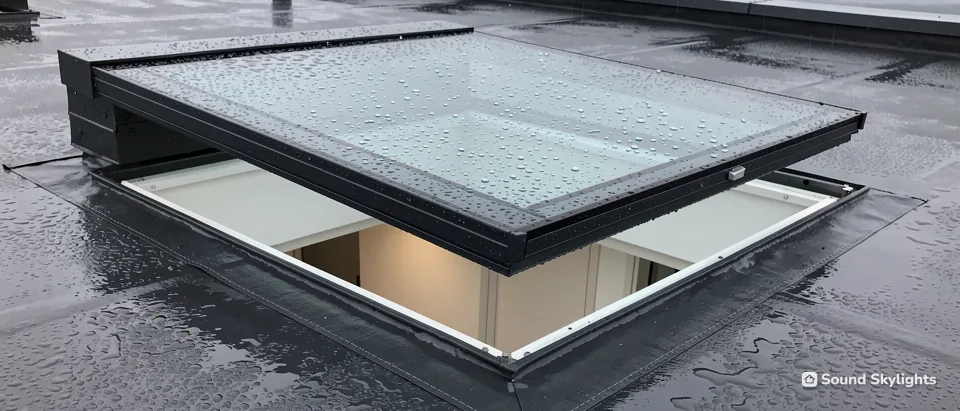
A fixed rooflight asks nothing of anyone once it is fitted. An opening one is different, because somebody has to open it, and that somebody may be standing in a kitchen with wet hands or on a landing with a laundry basket. So the useful question about power is not which system sounds cleverer. It is which one you will actually use on an ordinary Tuesday.
There are two ways to power the motor that lifts the glass. A mains unit takes a cable from the house supply. A solar unit generates its own supply from a cell on the frame and needs no cable. Each makes sense in some rooms and a poor fit in others. The overview of electric opening rooflights sets out the whole family; this page is about choosing between the two, and a skylight on a high ceiling is where the choice matters most.
What each one is like on an ordinary day
From the floor, the two feel almost the same. You press a button on the wall or on a handset, the glass opens, and you press again to close it. The difference sits out of sight, in how the motor gets its energy.
A mains unit draws on the house supply. A solar unit draws on a battery that the cell on the roof tops up, so what it does depends partly on the light the cell receives. The maker's own literature explains how a particular model behaves when the battery is low, and that detail is worth reading before you choose rather than after the first grey fortnight.
Think of the person who will use it most: a parent with a baby on one arm, a teenager running late, a relative who cannot stretch. The best system is the one that person reaches for without a second thought. Neither kind removes the need for a routine. Somebody still decides when the glass opens, and somebody still decides to close it before leaving the house. Our page on rooflight rain sensors covers a feature some makers offer that helps with the second job.
Mains: what gets wired in and where the cable runs
A mains rooflight needs a supply point near the frame and a route for the cable to travel from one to the other. On some models a small transformer sits between the two and lowers the voltage for the motor. The maker's installation sheet decides where the transformer lives and whether you must be able to reach it.
The route is the part that changes from house to house. A new extension has an open ceiling, so the cable goes in before the plasterboard does. A finished room offers fewer choices: the cable might thread through the space above, sit in surface trunking, or follow a wall, depending on what lies above the plaster. We look during the free survey, because a photograph cannot show the space between the joists.
A wall switch adds a second run. The switch goes where your hand falls on the way into the room, and the cable has to reach it as well as the motor. If you would like one switch to work two rooflights on a landing, say so then: group controllers that drive two windows at once come from some makers, and the cabling follows that choice.
| Situation | Cable route | Planning point |
|---|---|---|
| New extension, ceiling open | Laid before the boards go up | Settle the switch position early |
| Finished room, void above | Threaded through the space above | Seen at survey |
| Finished room, no void | Surface trunking or down a wall | Depends on the finish you accept |
| Two rooflights, one switch | A run to each unit | Ask the maker about a controller |
Solar: a cell on the roof and nothing to run through the house
A solar rooflight has a panel on its outer frame that feeds a battery, and the battery drives the motor. Nothing has to be chased into plaster, which is why solar is worth a look where a decorated ceiling would otherwise have to be opened up for a cable.
The same panel is the reason to check the position. A cell works from daylight, so a unit in the shade of a tall neighbouring wall or a big tree gets less to work with than one on open roof. Makers differ on how large the cell is, how the battery is looked after, and what the window does when the charge runs low, so none of this can be assumed from a general description. Ask for the model's own information and read the section on low battery.
It also helps to think about how the glass is used. A rooflight opened once for steam and closed again draws very little compared with one that is cycled many times a day, and a family that opens it constantly is a different case from a spare bedroom used at weekends.
A wall switch, a handheld remote, or both
Both mains and solar units are controlled the same few ways, so this choice is separate from the power question, though some makers sell particular controls with particular models.
The wall switch. It sits by the door, never gets lost, and nobody has to remember where it was put down. A landing, a hall or a kitchen where one person opens the glass each morning is where it earns its place. The drawback is that it works only from that spot.
The handheld remote. It can sit on a worktop or a bedside table, so the glass can be raised without getting up, and it is easy to hand to someone who has difficulty reaching a wall. The drawback is that it can go missing, or end up in the hands of a small child.
Both together. A switch for the daily job and a remote kept in one chosen place can cover every case. Where the room is shared by several people, agreeing the place for the remote is more use than any amount of technology.
If the same maker's blind is motorised, ask whether the same handset can run it. Some makers offer a matching motorised blind; whether it shares a controller depends on the model.
Settle these about the controls
- Where the wall switch goes, at a height every user can reach
- Where the remote lives, and who can get hold of it
- Whether one control should run more than one rooflight
- Whether the blind shares the handset
- What happens to the glass if the control stops responding
Which rooms suit mains and which suit solar
Think about the room first and the power second. A kitchen under a flat roof can be a good candidate for mains: the extension may be mid-build or opened up anyway, the supply can be close, and the glass may be opened several times while cooking. The head of a staircase can suit whichever route is easier to reach. A bedroom in a loft conversion is a good place to compare them, because the ceiling is already finished and a cable may mean disturbing it.
Bathrooms need more care. Controls and wiring in a damp room are chosen for it, and a solar unit avoids a cable altogether, though the position of the cell still matters. The Victorian terraces of Edgeley and Reddish, with lofts and back additions short of light, and the bungalows of Bramhall and Heald Green, many with an extension already on the back, each throw up different answers because the roof and the ceiling differ.
None of this is a rule. These are questions for the survey, asked under the actual ceiling, and the answer can differ between two houses on one street.
| Room | Mains suits when | Solar suits when |
|---|---|---|
| Kitchen extension | The ceiling is open or a void is above | The finished ceiling cannot be opened |
| Landing or stairwell | A supply point is close | A cable would cross a decorated hall |
| Loft bedroom | The slope lining is still to be done | The room is finished and sunny |
| Bathroom | The route can be planned for damp | The roof has open sky above it |
A power cut, a flat battery and a sticking motor
Every motorised fitting has a moment when the power is missing, and it is sensible to know in advance what the glass does then. Whether a given unit can still be worked by hand with the supply off varies, so read the maker's data on that point. If it stays where it is when the power goes, you want to know before the weather turns.
With mains, the question is the supply. With solar, it is the battery, and the same worry arrives in a long spell of cloud. Neither is a fault in the idea. It means that for a room where the glass must be reachable in all conditions, such as a bedroom you want to ventilate, the survey conversation should include what the unit does with no power at all.
A motor is also a moving part. Follow the maker's manual about cleaning round the arm and about what the glass should and should not be asked to lift, and do not hang anything on the arm. We go through the handling at handover, so you are not working it out from a leaflet alone.
Ask what the glass does with no power before you ask what it does with plenty.
How the decision is made at the survey
The free survey is where the choice is settled, ahead of any figure. The cable route itself has to be seen in person, though a ceiling snapshot sent ahead to WhatsApp 07880 284133 saves a step. Where the work is notifiable, we handle the Building Regulations notification with the council's building control team or a registered building control approver.
Money comes later and follows the survey. For the money side, see what moves electric rooflight cost, which explains why mains and solar differ, and for an existing roof, swapping a fixed rooflight covers the opening itself.
From first visit to handover
- Look at the room. Ceiling height, who opens it, and what sits above the plaster.
- Choose the power. Mains where a cable route exists, solar where it would cost the finish.
- Choose the controls. Switch, remote or both, and where each lives.
- Fixed written quote. Agreed before any order goes to the maker.
- Handover. You press every control, and the blind and cleaning are explained.
Want this looked at on your own roof?
- Fixed written quote
- We handle the Building Regulations notification where the work is notifiable
- 10-year workmanship guarantee