Replacing misted rooflights and roof windows

Misted rooflights in Stockport

Cloud between the panes means the sealed unit has failed. The glass unit can be swapped alone, or the whole window replaced.

Takes you to the survey form on this page and adds your postcode to any WhatsApp message.

  • Fixed written quote
  • We handle the Building Regulations notification where the work is notifiable
  • 10-year workmanship guarantee
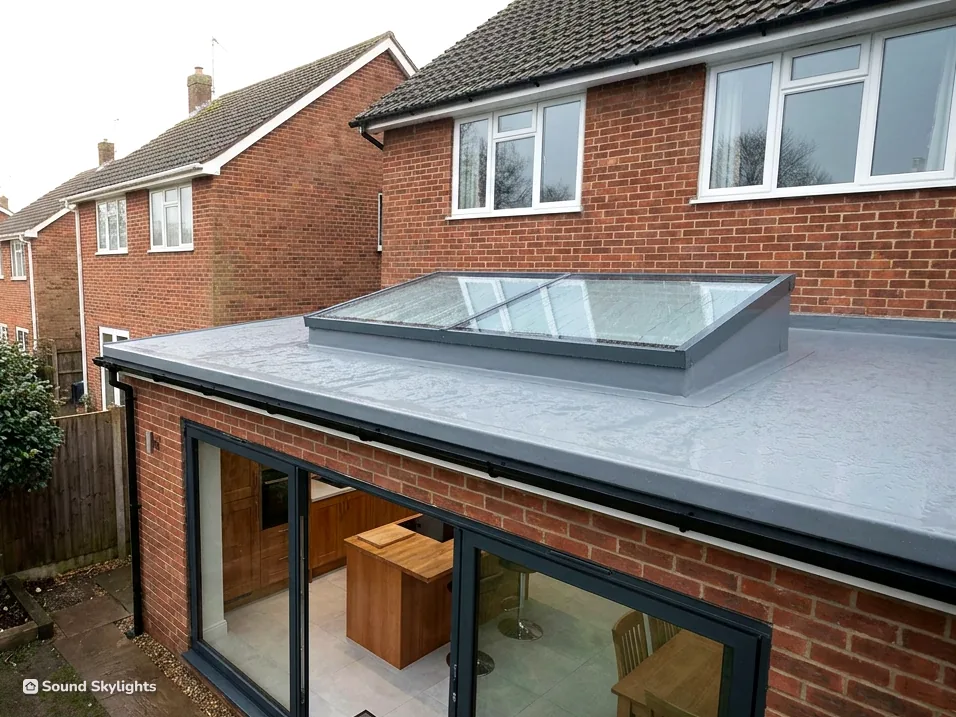
The back of a brick semi with a flat rooflight on its single-storey extension

A misted rooflight is one where a grey film or water droplets have appeared between the two panes of glass. It cannot be wiped away, because it is inside the sealed unit, and it dims the light you fitted the rooflight to get. The units we replace sit in pitched roof windows, on flat roof rooflights and in lanterns, and the job is either a new sealed glass unit alone or a whole new rooflight, as the frame and the roof allow.

The visit for a misted unit is a free survey, after which comes a fixed written quote. That includes houses, extensions and small commercial roofs in the Stockport area and the towns beyond it. For every product we fit, see skylight and rooflight replacement in Stockport.

A bright room under a flat rooflight, with an exposed beam and oak doors

Glass, opening and blinds on a replacement

  • The survey tells you whether the frame is sound enough for a new glass unit, or whether the whole window is better replaced.
  • If the old window was awkward to reach, this is the chance to choose a control rod, an electric opening unit or a solar one instead.
  • Blinds are fitted to the window's own size and maker, so a replacement is the moment to pair one with the room.
  • The outer glass is cleaned by turning a pivot sash to face the room, or from outside on a flat unit; the routine is explained at handover.

Failed sealed units

Mist between the panes: telling it apart, finding the cause, choosing the fix

Mist or condensation, why seals fail, glass unit or whole window, heat loss, waiting and what goes in writing.

Cloud inside the glass means the seal has failed, and nothing done in the room will clear it. What is left to decide is what to replace, how the new unit is measured and what it has to meet.

How can I tell mist between the panes from damp on the glass I can wipe?

The wipe test

On a morning when the glass looks cloudy, wipe the face that is inside the room with a dry cloth. If the cloud clears, it was condensation from the room's own air, and it points to damp air and cool glass, not a failed unit. Then, from a ladder at a window you can safely reach or from the ground with binoculars, look at the outside face. If neither face clears, the cloud is between the panes.

What a failed seal looks like

Inside a failed unit you might see a hazy white film that moves with the weather, a ring of droplets round the edge, or a milky patch that spreads from one corner. Some units show the mist only on a humid day and clear on a dry one, which can fool people into thinking it has gone. It has not. The sealed gap is no longer sealed.

Rain running down a timber-framed roof window, seen from inside

What to note before we visit

  • Which rooflights are affected: one misted unit in a house of several may point to one batch or one fitting, while all of them clouding together points to something else.
  • The side of the house the window faces, and whether the cloud changes with the weather.
  • Whether a blind is in the way.
  • The maker's name, if it is printed on the frame or the glass spacer.

These small facts shorten the survey. A photograph taken in daylight from below, with the blind open, and sent to WhatsApp 07880 284133, tells us what to bring.

Condensation on the room face

Steam from cooking, bathing and drying clothes settles on cool glass as droplets on the room side. The cure is moving that damp air out: an extractor fan, a vent or an open window. Pulling a blind across holds the wet air against the pane, so it is better left open until the room has dried.

What it is not

Mist inside the unit is not a leak through the roof. A rooflight can let in water through a poor flashing or kerb joint, and that looks different: stains on the ceiling lining, drips from the frame, damp round the opening. A new glass unit does nothing for water coming in at the frame, so the two are worth telling apart.

Two wipes

If wiping both faces leaves the cloud where it was, the glass unit has failed.

Why does the gap between the panes cloud over at all?

A sandwich with a sealed edge

A sealed unit is two panes of glass held apart by a spacer round the edge, with a seal bonded to the glass. Between them sits dry air, or a gas the maker chose, and small crystals in the spacer soak up any moisture that was trapped when the unit was made. The whole thing is meant to stay closed for as long as the glass is in the frame.

When the edge seal lets go

Moist air can get in at the edge if the seal opens. Once the crystals in the spacer are full, nothing is left to hold the water vapour, and it shows up as mist on the inner faces of the glass. The causes include a flaw in how the unit was made, a seal that has been standing in water, or movement in the frame that stresses the edge. Our page on why rooflights mist between the panes goes through them in more detail.

Why a rooflight is a hard place for a seal

A rooflight faces the sky. Its glass takes direct sun, rain and cold, and the unit sits at an angle, so water can lie against the edge. That is a reason to look carefully at the glazing bars, the drainage and the seal when choosing a replacement, not a reason to avoid rooflights.

Does misting mean the fitting was wrong?

Not necessarily. A failed seal is a fault in the sealed unit, and it can happen in a rooflight that is fitted properly. But the way a unit sits in its frame can contribute, so the survey checks whether the glass has been held evenly, whether water drains away from the edge and whether the frame is carrying a strain. A new unit that goes into the same strained frame may meet the same problem, so the frame is checked as well as the glass.

Nothing you do in the room dries the gap. A dehumidifier treats the surface condensation described in the last question and has no effect on the sealed gap. The unit has to be replaced.

The sealed unit, part by part

Spacer
The strip that holds the two panes apart round the edge.
Edge seal
The bond that keeps outside air from entering the gap.
Desiccant
Moisture-absorbing crystals held in the spacer.
Gas fill
A gas some makers seal between the panes instead of plain air.
Low-e coating
A thin coating on one pane that holds back heat loss.

Can just the glass be replaced, or does the whole rooflight have to come out?

When a new glass unit is enough

If the frame is sound, square and straight, and the glass unit is the only thing wrong, a new sealed unit made to fit can go into the existing frame. This is the shorter job, and it keeps the roof opening, the flashing or kerb and the inside lining as they are. It also suits a window whose make and size are known, so the maker's glazing unit can be matched.

When the whole window is better

Sometimes the frame is the problem.

  • The wood may have swollen, or the sash may not close squarely.
  • The flashing round a roof window may have reached the end of its use.
  • The model may no longer be made, so a matching unit cannot be sourced.

Then a new unit in an old frame is a poor choice, and replacing the whole rooflight or roof window is the sensible one. It is also the moment to change the window for an opening one, a bigger one, or one with better glass. A glass-only job leaves the roof alone; a whole-window job opens the roof round the unit, so the flashing on a pitched roof or the kerb on a flat one is part of the work, and whatever goes in has to be watertight at its edges as well as in its glass.

Frames in aluminium, timber and uPVC

The frame material governs how the glass is held. An aluminium frame has a bead or a gasket that is lifted out and refitted. A timber frame has its own beading and needs to be dry and sound before a unit goes into it. A uPVC frame is lighter and may flex, so the weight of a new triple-glazed unit is one of the questions.

If you want a bigger window

Changing the size of the opening turns a like-for-like job into a new one. That means new cutting and trimming, a structure that has to carry the new rooflight, and Building Regulations approval, which generally applies. Where a window or roof window is enlarged or a new one created, Approved Document L says the total area of windows, roof windows, rooflights and doors should not exceed 25% of the home's total floor area, unless compensating energy-efficiency measures are taken. If you are tempted to go larger, say so when the frame is being assessed.

How the rules treat each route

Replacing only the glass, or a window in its existing frame, is not providing a controlled fitting, so the energy limits do not apply to that work. By contrast, a whole rooflight or roof window is a controlled fitting, so it should meet them, and Building Regulations approval usually applies. The longer comparison is in glass unit or whole window.

Glass unit or whole window
Question at surveyGlass unit onlyWhole window
Is the frame sound and square?YesNo
Is the make and size known?Yes, or can be foundNot needed
Do you want a different opening method?NoYes
Is the flashing or kerb failing?NoYes
Do energy limits apply?No, glass onlyYes, controlled fitting

How is a replacement unit measured, and is it made to order?

From measuring to handover

  1. Measure the frame. The glass opening, the thickness of the existing unit and the rebate it sits in are taken on the roof, to the millimetre.
  2. Confirm against the label. The figures are checked against the maker's size code or the label on the frame. VELUX codes work like this: the letter is the width and the digits are the height. Where an older window has lost its label, the measuring has the last word.
  3. Choose the glass. Coating, gas fill and glazing are picked for the way the room faces, within what the frame can carry.
  4. Order the unit. Where the window is a maker's own product, the maker may supply a matching unit from its range; an unbranded, older or odd-sized one can be ordered from a glazing manufacturer as a bespoke unit.
  5. Fit it. On a glass-only job the old glass is lifted out, the frame is checked and the new unit is bedded in. On a whole-window job the new rooflight goes in with its flashing on a pitched roof, or onto the kerb on a flat one.
  6. Explain the window. The controls, the blind that suits the room and the cleaning of the outer pane are covered before we leave.

Why the order comes after the survey

Ordering from a photograph is how the wrong size arrives. A unit that is a few millimetres out will not bed in properly, and the edge is where seals fail. A made to measure unit has to be ordered, so the measuring is done properly once, at the survey, which is free.

Picking the glass for the room

A kitchen that cooks in the sun might want a solar control coating. A bedroom might take a laminated pane. Double glazing with a low-e coating is one starting point, some makers add a triple-glazed option, and every choice has a price and a weight. A heavy unit in an old frame is a reason to consider a whole new window.

Frames and finish

If the frame is staying, its material matters. Aluminium frames take a replacement unit differently from timber or uPVC, and the bead or gasket that holds the glass is part of the check. What the survey finds is explained on the day, along with whether the frame can take the glass you have in mind.

Thickness, weight and the frame's capacity

A replacement unit is not always the same thickness as the one it replaces. A thicker unit with a wider gap, or an extra pane, adds weight and may not sit in the rebate the frame was cut to. If the unit would be too heavy or deep for the frame, that is another point towards replacing the whole window, and we say so rather than squeeze it in.

Does it matter if the misted unit is a roof window, a flat rooflight or a lantern?

Roof windows on a pitched roof

A roof window in a slate or tile slope, from VELUX or another maker, is a sealed unit in a frame that pivots or opens on hinges. In a loft conversion the glass is above a bed or a desk, so a misted pane is a daily nuisance. The page on roof windows covers them.

Flat roof rooflights

Over a flat roof, a rooflight sits on a kerb. A glass-only job leaves the roof covering untouched, which is why it is the smaller job. The units can be large, and a failed one on a kitchen extension takes light away from the room where you are cooking most days.

A man at the stove in a kitchen with a brick wall, sunlight coming through a flat rooflight

Roof lanterns, sun tunnels and others

  • Lanterns: a lantern has several panes, and one can fail while the rest are clear. Replacing the single unit is possible where the glazing bars allow it, and our roof lantern page covers lanterns more widely. An orangery or conservatory lantern is a larger version of the same case, with more panes to check.
  • Sun tunnels: built differently from a sealed unit, so a cloudy dome is a separate question; our sun tunnels page explains how one is built.
  • Polycarbonate: some rooflights are glazed in polycarbonate rather than glass, and polycarbonate is replaced as a sheet, not as a sealed unit.
  • Walk-on: the glass is built for a stated load, specified by the maker, so a replacement unit should be matched to that load.
  • Conservation: a slim, flush profile can make this a whole-window question rather than a glass-only one.

Extensions and loft conversions

On a kitchen extension, a misted rooflight dims the room that depends on it. In a loft conversion, a roof window over the bed or the desk is where you see the cloud every morning. Both are worth timing with any other building work in the same part of the house.

Is a misted rooflight costing me heat, and will the new one do better?

Limits a replacement should meet

Roof window
A 1.4 W/m²K U-value, or Band B in the Window Energy Rating
Rooflight
2.2 W/m²K over the whole outer surface
Replacement element
No worse than what it replaces
Glass only, in existing frame
Not a controlled fitting

These are Approved Document L guidance for existing homes in England.

What a failed seal does to the numbers

A sealed unit is measured for its heat loss, expressed as a U-value, with the gas fill and the coating counted in. Once the seal has failed, the gap holds moist air instead of the gas the maker sealed in, and the figure on the datasheet may no longer describe the unit. How much warmth is lost varies with the unit and the room. Our page on misted rooflight heat loss goes into it.

What a new unit should meet

In England, a new or replacement roof window in an existing home should have a U-value no worse than 1.4 W/m²K, or a Window Energy Rating of Band B or better. Those limits sit in Approved Document L. Rooflights have a limit of their own: for one added or replaced in an existing English home, Approved Document L gives 2.2 W/m²K as the U-value to reach or beat. Lanterns, by the definition in Approved Document L, fall in the rooflight group. A replacement element should also be no worse than the one it replaces. For a rooflight, the U-value is based on its whole outer surface, which is often larger than the hole in the roof.

Glass choice against aspect

Insulation and daylight pull in different directions. Triple glazing, a low-e coating and a gas fill all raise the unit's insulation, and each one also changes how much light and warmth from the sun reaches the room. For a south-facing kitchen, a solar control coating might be worth more than extra glass. For a north-facing landing, daylight is the priority. A bathroom wants a damp-friendly finish, a bedroom may want the option of blackout, and a home office wants control of glare.

Shading and condensation after the change

Pleated and roller blinds can cut glare and add a layer in winter, and some makers offer solar control or blackout fabrics. A blind is cut to the window's size, so it can be chosen alongside the glass. A new, sound unit stops the cloud between the panes, but it does not stop condensation on the room face in a steamy bathroom. That comes from the air in the room, and a vent, an extractor fan or an opening window handles it. A blind pulled across while the room is wet holds the damp against the pane, so it stays open until the air has cleared.

How long can I live with a misted rooflight before I need to act?

A misted unit is still a window. The frame, the flashing and the kerb can still be doing their jobs, and the mist is a fault in the glass, not in the roof. Leaving one for a season while you plan is a reasonable choice. In the meantime, note whether the cloud spreads; a photograph taken now and another in a few months shows the change.

Waiting costs light first. A misted pane lets through less than a clear one, and in a loft room or an extension that was built around the rooflight, that dulls the room's main feature. It can also cost the view of the sky, and the insulation described in the last question. It does not let the seal heal. If you are already planning a loft conversion, a new kitchen or a re-roof, line the rooflight up with it so the roof is only opened once.

A blind will cover the cloud and keep the room comfortable, and it is a fair stopgap in a bedroom. It does not change what is happening in the glass, and it cuts out the light you wanted, so it works as a pause while you decide, with the replacement still to come.

Book the survey, get the fixed written quote and decide in your own time. Our page on how long you can leave a misted rooflight sets out the questions to ask yourself. If other work is booked, tell us, because it changes what we recommend.

Can a replacement make the rooflight easier to use?

Opening

If the old window was fixed, or was awkward to reach, replacing it is a good time to change that. A manual window can be operated with a control rod. Electric and solar opening versions exist from some makers, and our page on electric opening rooflights explains where they make sense. Ventilation on a replacement is checked at survey, along with the glass height and the reach of whoever uses the room.

Reach for the child or the relative

Where a child sleeps beneath the window, or the room belongs to an older relative, think about reach before you pick the opening method. A control rod kept in a cupboard, a remote kept on a high shelf and a restrictor on the opening are all options. Choosing at replacement time means the window can suit the person who actually uses the room.

Blinds and cleaning

Each blind is cut for one window size and maker. Bedrooms may want blackout, kitchens a lighter fabric, bathrooms a damp-room blind. A replacement is the moment to fit a new blind to match, because the old one may not fit the new frame.

The outside of a centre-pivot roof window turns to face the room. A flat rooflight or lantern gets washed by a water-fed pole used from below, or by someone on a ladder at the roof edge. Walk-on rooflights are the only kind designed to be stood on, and no one should climb onto any other.

Closing it properly

An opening window is only weatherproof if it shuts onto its seal, so we point out how to check that it has seated. On a pitched roof the flashing and gasket together keep the opening watertight, and on a flat roof the kerb does the same. Maintenance is light: wipe the glass, keep the drainage clear of leaves and look at the seals now and then.

Does the council need to know, and what is in writing?

What moves the price

A replacement is priced from the survey

Book a free survey

Priced once we have surveyed, and only then put into a fixed written quote.

  • Glass unit or whole windowA new glass unit is a smaller job than a new rooflight.
  • Size and shapeLarge, odd or bespoke units take more making.
  • Glass choiceGlazing choice, solar control and other coatings.
  • AccessReaching a roof by ladder differs from a scaffold job.
  • Opening and blindSwitching to an electric opening unit or fitting a new blind.

Planning

In England, putting a rooflight into a house is usually Class C permitted development, as long as it keeps inside the limits. Our planning permission guide sets out the Class C limits, side slopes included.

Building Regulations

Building Regulations approval is usually needed to replace a window or roof window. Glass-only work, as described earlier, sits outside the energy limits. Where the work is notifiable, we handle the Building Regulations notification with the council's building control team or a registered building control approver. Any replacement roof window should still meet the energy limits we gave above, and fire performance near a boundary is checked at survey. The Building Regulations guide sets out the detail.

Homes and small commercial roofs

A house, an extension or a small commercial roof gets the same sequence: a survey of the frame and the glass first, then the fixed written quote. A shop or an office with a failed flat rooflight is welcome too. For a flat roof that means the kerb and the upstand are looked at alongside the glass, and for a pitched roof the flashing is part of what the survey records, since the condition of either bears on whether the existing frame is worth keeping.

The survey, the quote and the guarantee

No price is given before the free survey, and a photograph alone never sets one. What the frame and glass show at the visit shapes a fixed written quote, and our misted rooflight cost answer sets out what moves it without quoting figures. Where the window is a branded product, the maker's range sets which units and parts are available, and makers' own guarantees differ from maker to maker. On a misted-unit job, what you hold for the fitting is a written copy of our 10-year workmanship guarantee, and the guarantee page says more.

Sealed unit queries

Should I replace the glass unit or the whole misted window?

The answer turns on the frame. Sound, square and from a maker whose units can be matched points to a new sealed unit, which is the smaller job; anything less points to a whole window. Glass unit or whole window compares the two properly.

Why has the glass in my rooflight clouded between the panes?

The edge seal of the sealed unit has opened, moist air has entered and the moisture-absorbing crystals in the spacer are full. The cloud then sits on the inner faces. See why rooflights mist for the usual causes.

What does it cost to clear a misted rooflight?

It depends on whether you need a new glass unit or a whole rooflight, the size, the glass and access to the roof. We survey free of charge, and the fixed written quote follows. Our cost answer lists the factors.

Is a misted rooflight losing heat from my room?

Once the seal has failed, the datasheet figure may no longer describe the unit, and a new one should meet the current limits. Read misted rooflight heat loss for how to think about it.

Can I leave a misted rooflight for a year or two?

If the frame and flashing are sound, the window still keeps the weather out, so it is your decision. The costs are the light and the view you lose. The seal does not heal. Our page on how long you can leave one explains the trade-off.

Do you replace misted units in a VELUX window?

Yes, in VELUX and other makers' roof windows. We work from the maker and its size code, and either fit a new glass unit or replace the whole window. Our VELUX windows page has more on that range.

Does a misted conservation or walk-on rooflight need a different approach?

Yes. A walk-on unit has glass built for a stated load, specified by the maker, while the slim frame of a conservation rooflight can mean replacing the whole thing. See walk-on rooflights and conservation rooflights.

Will the replacement need Building Regulations approval?

Replacing a whole roof window usually does. Work on the glass alone, in its frame, sits outside the energy limits. Our Building Regulations guide explains what building control checks.

Free survey

Book your free survey

Tell us about the room and the roof. We visit, measure and send a fixed written quote for the job in Stockport.

  • Fixed written quote
  • We handle the Building Regulations notification where the work is notifiable
  • 10-year workmanship guarantee

Request my survey