
Our house is on the former hall estate. Does the age of the roof change the window?
The Culcheth Hall estate has been developed as housing since the hall was demolished after the Second World War. The age of your own house is something we confirm at the survey, because it matters to the roof. Houses built from the 1960s onward typically carry lower-pitched roofs of concrete interlocking tile, unlike pre-war houses. If yours is one of them, a roof window is fitted with a flashing kit made for that covering.
Why the pitch matters
On a lower pitch, the glass looks up at more sky and less of the horizon. In summer that means more sun on the pane, so a blind inside, or solar control glass, is worth thinking about early. The page on flashing where slate and tile meet a window explains how the kit and the covering go together.
Pivot or top-hung
Which way the sash moves changes how the room feels. A centre-pivot window turns on a bar across the middle, and a top-hung window is hinged along the top. The choice depends on how high the window sits and what is under it, such as a bed or a desk. Our guide to centre-pivot or top-hung sets the two side by side.
Who works the handle
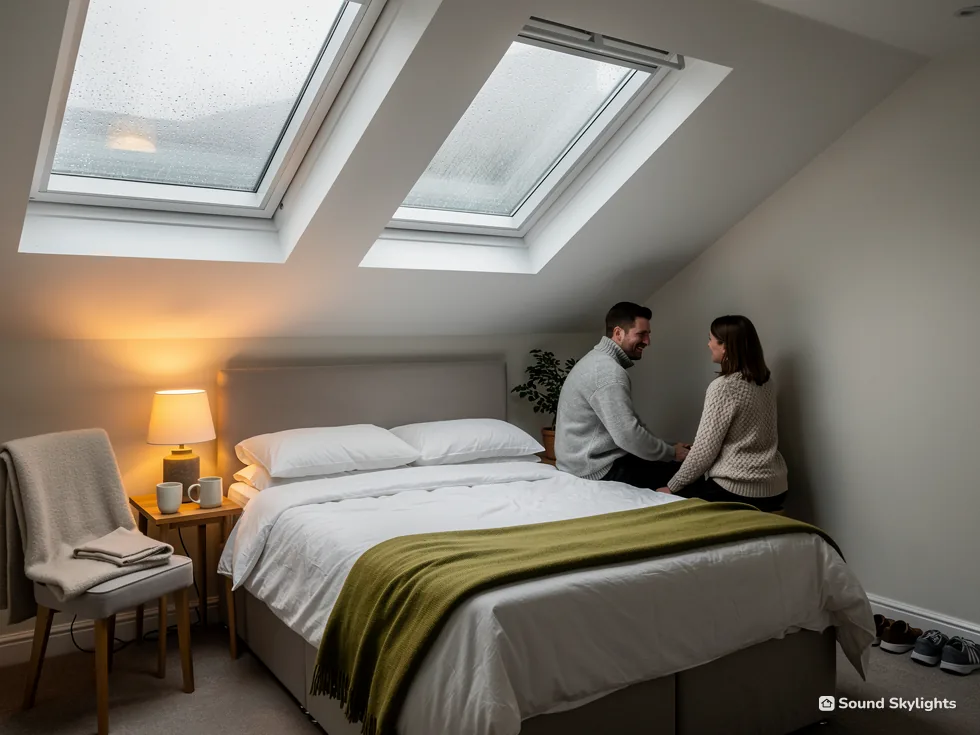
The best window in the world is a nuisance if nobody can reach it. At the survey we stand where you will stand, and decide whether a hand, a rod, a remote or a motor makes sense. That decision matters more than the model name on the box.
Blinds for the afternoon
A south or west slope can put hard sun on a pane for hours. A blind on the inside cuts glare, and VELUX makes awning blinds for the outside of the glass to hold back heat, while a blackout blind suits a bedroom you want dark at any time of day. Our guide to blinds and controls shows how they are worked.