The photos sell a rooflight on its first sunny morning. This page is about every morning after that: who reaches the handle, what happens when the sun is on the bed at six, how the outside glass gets wiped, and what to do when rain comes on with the window open. These are the questions we ask at every survey, because the answers decide which skylight suits the room.
We have set it out product by product, then by topic. Each part links to the page that goes deeper, and the services index lists every type we fit.
Pitched roofs
Roof windows: centre-pivot and top-hung
A pitched roof window opens in one of two main ways. On a centre-pivot window you find the handle on the top bar of the sash. Pull it down towards you and the upper edge tips inward while the lower edge moves out, pivoting part way down the frame. It suits a room where furniture sits under the window, because the sash stays clear of the space below. Turned right round, it brings the outer pane inside so you can clean it from the room.
A top-hung window swings from hinges along its head, opening outwards from the bottom, with the handle at the foot of the sash. It leaves a clear opening to stand at and look out, which suits a loft room with a low wall in front of the window. Some top-hung models can also swivel for cleaning, depending on the maker. Centre-pivot or top-hung: choosing how a roof window opens compares them in detail.
VELUX and other makers
VELUX windows follow the same patterns, and the maker sells blinds matched to the window's size code, plus control rods and motor kits for its own ranges. Other makers offer their own versions. When an older window is replaced, the new one can open a different way if that suits the room better.
| Type | Handle | Good for |
|---|---|---|
| Centre-pivot | Along the top | Furniture below, cleaning from inside |
| Top-hung | At the bottom | Standing at the window, low walls |
| Electric or solar | Switch or remote | Ceilings out of reach |
Flat roofs
Flat rooflights and roof lanterns
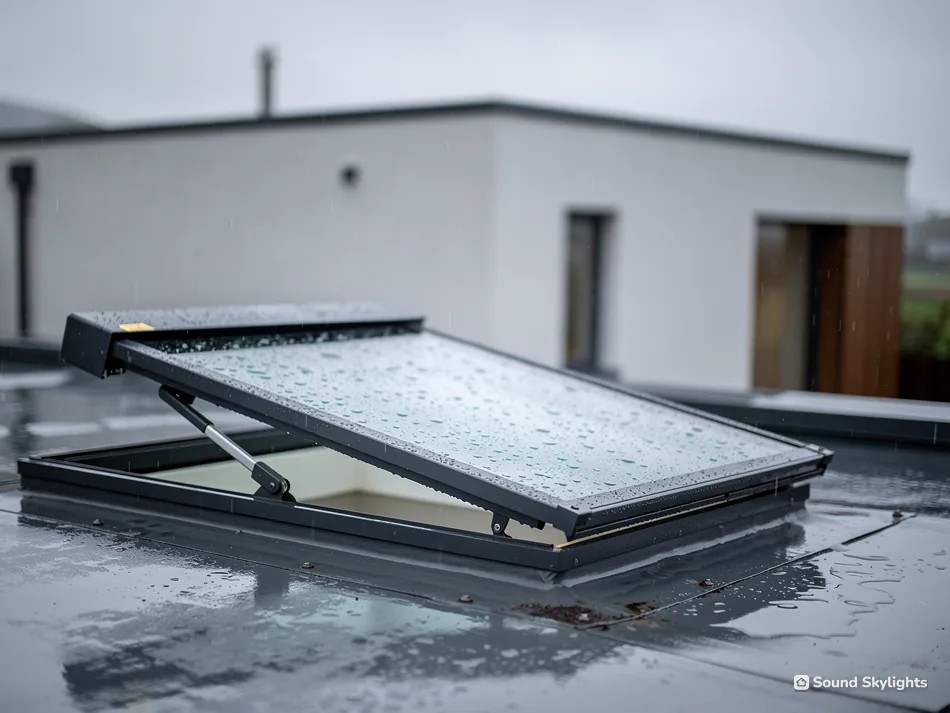
A flat roof rooflight can be fixed, hinged or sliding. A fixed one gives light and nothing else to think about. A hinged one lifts on a motor or a manual winder, depending on the maker. A sliding one moves along its frame rather than lifting, and is chosen for particular roofs where that suits.
A roof lantern is mostly fixed glass. Some makers offer opening vents in the sides or the roof of the lantern, worked by an electric motor on some models. Whether a vent is worth having depends on the room: it is one more thing to open and shut, so we talk through who would use it.
Walk-on glass
Walk-on rooflights are fixed panels you can walk across, laid into a terrace, a balcony or a lightwell. Daily use is mostly about the top surface: keeping it clear and dealing with a wet finish. The answer on wet walk-on glass covers the grip finishes makers offer.
Older houses
Conservation rooflights and sun tunnels
A conservation rooflight lies almost flush with the slates and, depending on the model, opens by hand, with a stay or a winder that holds it at a chosen position. The opening style varies by maker. Older Victorian and Edwardian houses can have tall ceilings, so reach is worth thinking about early: some makers offer a winder that can be turned with a pole, and some offer motors.
A sun tunnel does not open at all. On top is a clear dome; below it, a tube carries daylight through the loft space to a ceiling diffuser in the room. Living with one is mostly about the diffuser, which can be wiped from below when dust or a dead fly gathers, and whether it suits the room in the first place. Our sun tunnel room guide helps decide.
Settle who will open it, and how often, before choosing glass or frame.
Controls
When the handle is out of reach
A rooflight over a stairwell, in a vaulted kitchen or in a tall Victorian room can sit well above anyone's reach. If that is the case, a manual handle means it never gets opened, and the room goes stuffy in summer since fetching steps every time soon gets old. There are three ways round it.
A control rod
A rod clips onto the handle and lets you work the window standing on the floor. There is no power to arrange, but it suits a window within a rod's length, and someone has to be able to lift and guide it.
Electric opening
A mains motor lets you open the window from a wall-mounted switch or a hand-held control, depending on the maker. The cable route from a supply to the window is planned at the survey. The electric opening rooflights hub covers motors and switches in full, and the answer on swapping a fixed unit for an opening one covers replacements.
Solar opening
A solar model carries a small panel and battery on the window and needs no cable to the room, which can suit a finished ceiling that nobody wants to disturb. Our comparison of electric and solar weighs the pair up.
Questions that settle the control
- Can the person who opens it reach the handle from the floor?
- Is there a power supply near enough for a cable route?
- Would a remote be kept in the room or get lost around the house?
- Does anyone in the house find lifting a rod awkward?
Shade
Choosing a blind for the room
A rooflight faces the sky, so sun can fall straight into the room, and shade is worth planning from the start. The right blind depends on the room. In a bedroom, a blackout blind keeps early summer sunrises off the bed. In a kitchen or office, a pleated or roller blind softens glare on a screen or a worktop without making the room dark. In a bathroom, some makers offer blinds made to cope with damp, which matters where steam rises straight to the glass.
Roof window blinds are sized to one maker's window and its size code, so the blind is chosen with the window rather than picked up later from a shop. Some makers offer electric or solar blinds that answer to the window's own handset. For VELUX windows, VELUX blinds and controls: choosing for the room lists the options for each room.
Lanterns and large flat rooflights are harder to fit with a blind. Some makers offer integral or fitted blinds for certain models; for others, glass with a solar control coating does some of the work instead. Our note on solar-control glass sets out its limits.
Cleaning
Getting the outside glass clean
Inside glass is easy: a cloth and a step. The outside depends entirely on the product.
- Centre-pivot roof windows rotate a full half-turn, bringing the outer pane round to you, and you wipe it from indoors.
- Top-hung roof windows open outwards; some models also swivel to bring the outer glass within reach, depending on the maker.
- Flat rooflights and lanterns are cleaned from outside, using a water-fed pole from the ground or from a ladder set against the roof edge. They are not for standing on.
- Walk-on rooflights are the one type designed to be stood on, so the top can be swept and washed like the terrace around it.
- Sun tunnel domes sit up on the roof, out of the way; the diffuser inside is the part you wipe.
Self-cleaning coatings exist on some makers' glass. They help rain wash dirt away but do not make cleaning unnecessary. We explain which way your unit is cleaned before we leave, so nobody climbs onto a flat roof or a lantern to find out.
Weather
Rain sensors, and leaving it open
A window left open when a shower arrives is an easy thing to worry about. On a manual rooflight, the answer is habit: close it when you go out, and choose a position for it that you can reach quickly. On electric and solar models, some makers build a rain sensor into the window that closes it when it detects rain. It is a feature of particular models, not of every opening rooflight, so it is checked when the unit is chosen.
A sensor may need a little rain on it before it reacts, so a few drops can get in before the window shuts, and it cannot help on a manual unit. The guide to rooflight rain sensors covers how the makers describe them.
Family homes
Opening rooflights where children sleep
In a child's bedroom, the worry is a window that small hands can open. There are options, and the right mix depends on the room. Keep the handset on a high shelf. Some makers offer restrictors that stop the sash opening beyond a set point, and child-resistant catches. On a window that is out of reach anyway, the question mostly answers itself.
One caveat matters more than the rest. In a loft room or on an upper floor, where the floor of that storey is at most 4.5 m up from the ground, a roof window can be the escape window for that room, and any lock, restrictor or catch on it should still let an adult open it to the full escape opening in a fire. Over a two-storey house, a loft floor normally sits higher than 4.5 m, and there the escape route is normally a protected stair, not a window. Escape windows may have locks and opening stays (with child-resistant release catches), and should be able to stay open without being held. At the survey, then, we find out if the room depends on this window for escape, and choose the controls around the answer. The escape rules are in our Building Regulations guide, and the child's-bedroom answer covers the options in more depth.
Through the year
What changes from season to season
A rooflight asks different things of you as the year turns.
Spring is the time to clean the outside glass and check that gutters and the flat roof around a lantern or rooflight are clear after winter.
Summer brings the strongest sun straight through the glass. This is when the blind earns its keep, and when an opening rooflight high in the room gets opened more, so a window that is easy to open matters. Glass with a solar control coating can help a south-facing room.
Autumn fills flat roofs and gutters with leaves. Clearing them around an upstand helps rain run away as it should. It is also when showers come on suddenly, which is where a rain sensor on a maker's electric model earns its place.
Winter can bring droplets forming on the inner pane, especially in bathrooms and kitchens where the air is damp. That comes from water vapour indoors, not from a faulty window, and opening the window or a vent for a while each day helps. The answer on condensation explains why it forms. If snow or ice sits on the glass, leave the window closed until it has cleared.
A year with a rooflight
- Spring Clean the outside glass and clear the roof around it.
- Summer Use the blind and open the window when the room warms up.
- Autumn Clear leaves from gutters and upstands.
- Winter Let damp air out to keep condensation down.
Before we leave
What we show you on the last day
On the final day, the rooflight gets a run-through with whoever will use it: how it opens and closes, how the blind fits and works, where the remote or rod is kept, and the safe way to wash the outer glass. If something about daily use is still unclear after a few weeks, ask us. Where the work is notifiable, we handle the Building Regulations notification with the council's building control team or a registered building control approver. Workmanship on the fitting itself is protected for a decade by our 10-year workmanship guarantee. To book a free survey, use the form below.