Our landing is boxed in by bedrooms and has no daylight. Where can it come from?
A landing with bedrooms on both sides has no outside wall, so daylight can only come from above. What sits above the ceiling decides which of two routes makes sense.
Under an empty loft
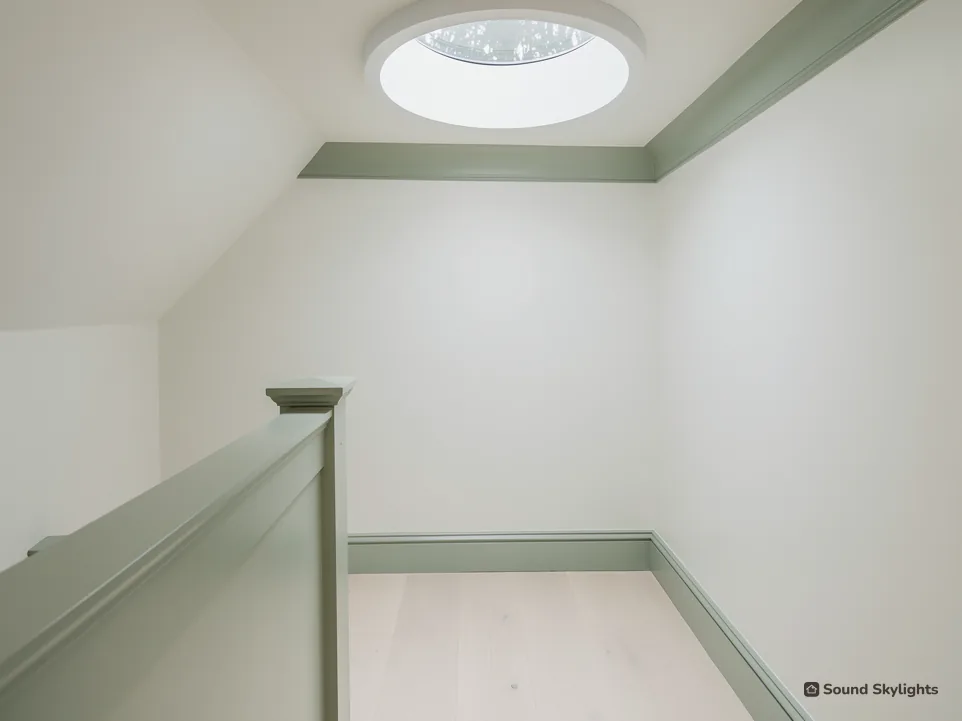
A sun tunnel brings daylight through a dome in the slope, a reflective tube across the loft and a frosted panel let into the landing ceiling. We cut a neat opening for the panel and finish the edge. Nothing about it opens and no sky shows through it, so it cures darkness and nothing else. The rigid or flexible guide explains the tube, and the rooms guide shows where it falls short.
Under a loft room
If the loft has been converted, a roof window in that room can send light down the stair, or the stair can borrow light through an internal glazed panel. A roof window opens, but a handle over a stairwell can be a long way up. Pole, handset or solar cell: pick before you order.
Who uses the stair
A stair is shared by the whole house, which favours the option with nothing to operate. A sun tunnel has no handle and no motor. Where a window is wanted for the opening, the electric or solar comparison helps choose the control.
The usual mistake
It is easy to choose the window first and the control afterwards. Reverse that: decide who will open it, how often and from where, and the window follows.
Another mistake is to put a fixed light where an opening one was needed, or the reverse. We ask what the landing is like in summer, since a stairwell can hold heat, before we recommend either.
A boxed-in landing
Check the loft first. Empty means a sun tunnel, and a room above means a roof window.