Opening rooflights that work from a switch

Electric opening rooflights in Stockport

A motor or a solar cell raises the glass from a button, so a ceiling out of arm's reach stops mattering.

Takes you to the survey form on this page and adds your postcode to any WhatsApp message.

  • Fixed written quote
  • We handle the Building Regulations notification where the work is notifiable
  • 10-year workmanship guarantee
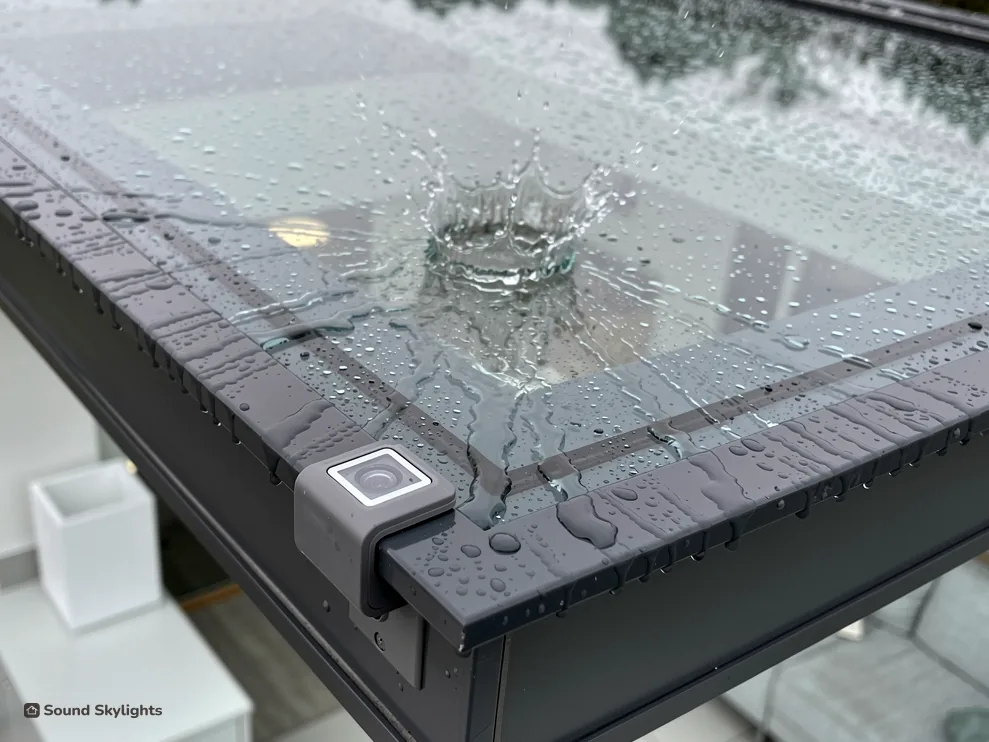
A raindrop splashing on rooflight glass beside the rain sensor on the frame

An electric opening rooflight has a small motor that lifts the glass for you at the press of a wall switch or a handheld remote, so a high ceiling stops being a problem. Solar versions do the same with a battery charged by a cell on the unit and no cable. We fit new ones in kitchens, landings and loft rooms, and swap fixed units for opening ones, in homes in Stockport and the towns up to 30 road miles out.

The free survey comes first, since the right unit follows the room and each person pressing the button; the fixed written quote is issued afterwards. For the wider picture first, our page on rooflight and skylight installation in Stockport covers every product we fit.

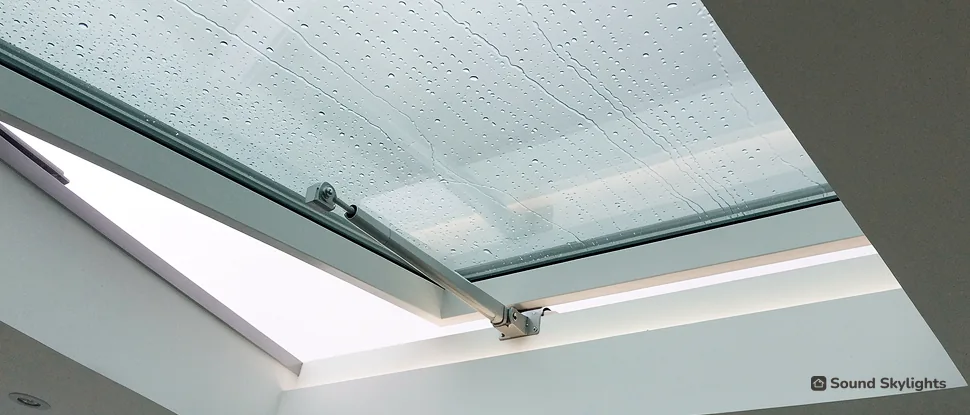
An opening rooflight seen from below, raised on its actuator arm

Opening, shading and cleaning by button

  • You press a switch or a remote button and the glass lifts on its arm. Press again and it lowers. No pole, no chair.
  • Some makers fit rain sensors to selected electric and solar units, and the maker says the sensor shuts the glass once drops land on it. Ask the maker whether the unit you like has one.
  • A blind is chosen for the size and maker of the unit, and some makers offer motorised blinds that match their opening windows.
  • Washing the top face of the glass happens from outside, and a flat rooflight is never a place to stand.

Power, rain and reach

A rooflight that opens from the wall: motors, solar cells and swaps

Which rooms suit a motor, mains against solar power, rain sensors, children, and changing a fixed unit for one that opens.

An opening rooflight with a motor is the glass, an actuator arm, a controller and a source of power, and each part is chosen against the room it goes in. A landing, a kitchen extension and a loft bedroom each pull the choice in a different direction.

Which rooms are best for a rooflight you open by pressing a switch?

Kitchens and dining tables

In a kitchen, an opening rooflight can be used every day. Cooking fills a room with steam, and a rooflight above the worktop gives it somewhere to go. A wall button by the doorway, or a handset left on the shelf, means nobody fetches a pole with a pan in one hand. A dining extension works the same way: the table sits under the glass, and on a close afternoon you open the roof without moving the laptop or the homework.
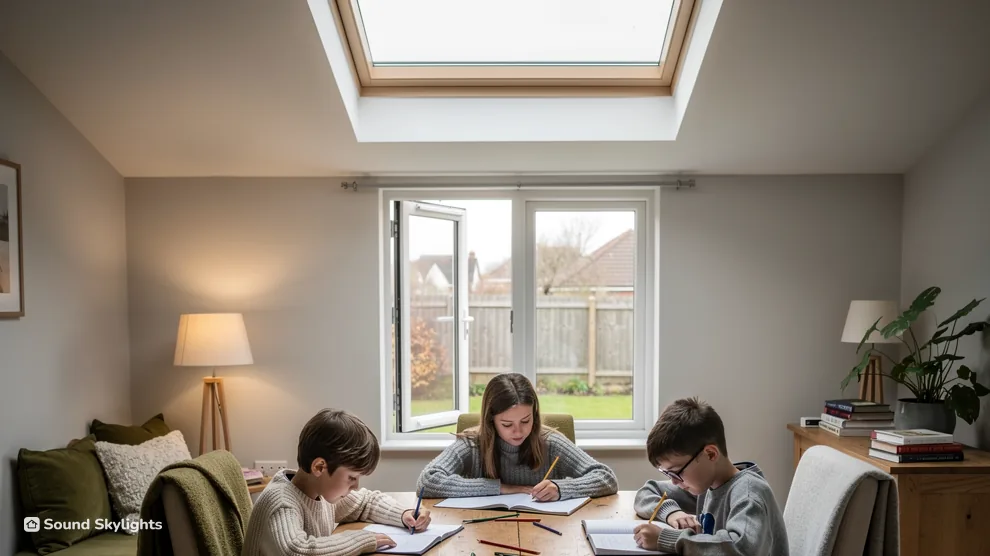
Three children doing homework at a dining table under a rooflight

Landings, loft rooms and bathrooms

  • Landings and stairwells: a skylight at the top of a stair can be a long way above anyone's hand. A fixed one lights the landing but cannot be opened. A motor puts the control on the landing wall.
  • Loft rooms: a loft conversion has roof windows over the bed or the desk, and you want to open them without climbing onto furniture.
  • Bathrooms: a window over the bath is the same story, with the controls and the wiring route chosen for the damp and a damp-room blind beneath it.

Extensions, orangeries and natural light

Add a kitchen to the back of a semi, or an orangery-style room under a flat roof, and the daylight that reached the house through the old rear wall is cut off. Over the centre of the room, a flat rooflight brings natural light down, and an opening one lets the same glass handle the kitchen steam. On a Victorian terrace in Edgeley or Reddish, a back addition that is short of light can take one over the worktop. A conservatory given a solid roof follows the same logic.

Where a pole is simply fine

Not every rooflight needs a motor. A window within easy reach opens by its handle, and one a little higher opens with a control rod. If the ceiling is low and the person using the room is tall and able, manual is the sensible answer, because an electric unit is a larger fitting than a manual one.

When does a motor beat a control rod?

Matching the opening method to the ceiling
Where the glass sitsHandleControl rodMotor or solar
Within arm's reachSuits itNot neededOnly if hands or shoulders are limited
A stretch above your headOut of reachSuits itWorth considering
Over a stair, void or tall roomOut of reachAwkwardSuits it
Over a bath or a bedOut of reachAwkwardSuits it

Reach and the person reaching

A rooflight you can touch from the floor needs a handle. One a stretch above your head takes a control rod, which is a long pole whose hooked end engages an eye on the frame. Beyond that, the rod becomes a nuisance: it is long, it has to be stored somewhere, and the window has to be lined up before it will latch.

Reach in older houses

A tall Victorian or Edwardian stairwell puts a rod well out of comfortable reach, and so does the sloping ceiling of a converted attic. The landing under a roof is a spot where a button beats a pole, because the person standing under the glass is a long way from it.

Who is pressing the button

Think about everyone in the house, including people who will never be the one ordering. An older relative who cannot raise their arms comfortably, a teenager who will never reach for a rod, a person who uses a wheelchair or a stick: each of them is better served by a button.

Switch, remote or both

A fixed wall switch goes where your hand falls naturally as you enter the room. A handheld remote can live on a shelf or a worktop. Some makers sell controllers that run several windows at once, which suits a landing with two rooflights. The pick depends on the room's habits, and we raise it before any order is placed. In a kitchen the switch can sit by the door; in a bedroom it is best where the person in the bed can reach it. A remote is easy to mislay, so it is worth deciding where it lives before the unit is fitted.

What a motor adds

A motor adds a cable or a battery, a controller and a part that can wear, and the fitting is more involved than a manual one. On a ceiling within reach, a handle does the job without any of that.

Roof window, flat rooflight or lantern: which of them can be electric?

Roof windows on a slope

VELUX and other makers sell electric and solar versions of their roof windows. A roof window lies flush with the slope, and a centre-pivot one turns about its middle, so it opens as a wide gap there. Where the existing window is a standard size, an electric one can sometimes take its place in the same opening. The page on roof windows goes into the options for pitched roofs, and the one on VELUX windows covers the maker's range.

Flat roofs and lanterns

A flat roof rooflight stands on a kerb and can be made to open, with the glass hinged along one edge and raised by an actuator. They fit well in kitchen extensions, utility rooms and corridors that have a flat roof above. Our page on flat roof rooflights covers the rest of that family.

Some makers offer a roof lantern with an opening panel in one pane, powered by a motor. It is a smaller opening than a hinged rooflight gives, and it suits a big extension where the lantern is chosen for its look and the vent is a bonus. Our roof lantern page covers the shapes.

Sun tunnels and walk-on units

A sun tunnel is a sealed light pipe and does not open. Walk-on units are built for standing on, and a fixed one is the sensible choice there. If you are choosing between an opening unit and a sealed one, the survey says which suits the room.

Glass, frames and makers

Opening units are glazed in glass, but some makers offer polycarbonate sheet on certain rooflights. The range from one manufacturer can differ from another in colours, in frame depth and in how the opening arm looks from below, so several brands are set against your room. Where a size is not in a maker's standard range, a bespoke, made to measure unit may be possible from the same maker.

Makers offer frames in aluminium, uPVC or timber depending on the product. Double glazing comes first, with triple glazing on some ranges, and the energy and finish options are chosen to suit the room.

Which products can be made to open

Roof window
Electric and solar versions from VELUX and other makers
Flat roof rooflight
Hinged glass on an actuator, from makers that offer it
Roof lantern
Some makers include a motorised vent pane
Sun tunnel
Sealed, does not open
Walk-on rooflight
Fixed, because it is designed to be stood on

Mains-powered or solar: what gets wired in, and where does the cable go?

Mains models

A mains-powered rooflight takes its power through a cable. On some models a transformer lowers the voltage for the small motor, but either way the cable has to get from a supply point to the frame. In a new extension, the route can be planned before the ceiling goes up. In an existing room with a finished ceiling, the route might run through a void above the plasterboard, or along a surface, or round the wall, depending on what is above the ceiling.

Solar models

Some makers offer a solar version of their opening roof windows, with a cell on the outside of the unit that charges a battery. There is nothing to run through the house, which is why solar can be the answer where a finished ceiling makes a cable impractical. The maker's own literature says how the battery behaves in dull weather and how the window copes when it is low.

When the power is off

Some opening units can be worked by hand when the supply fails, and some cannot. The maker's data holds the answer for the model you are weighing, and it is worth reading before the order rather than during the first dull week.

For the full comparison, read electric or solar opening rooflights.

Parts of an opening unit

Actuator
The small motor and arm that raise and lower the glass.
Controller
The box that takes your button press and tells the motor what to do.
Transformer
Lowers the house supply to the voltage the motor uses, on mains models that have one.
Solar cell
A panel on the unit that charges the battery, on solar models.
Rain sensor
A maker's option that shuts the glass when rain lands on it.

What happens if I leave it open and the rain comes in?

Going out for the afternoon and coming home to a wet sill is a familiar worry with any window. On a rooflight the stakes feel higher, because the glass is above you and the rain can fall straight into the room.

Rain sensors are a maker's feature

A rain sensor is a small detector on the unit, and the maker says it closes the glass when drops hit it. Some makers include one on their electric and solar models and some sell it as an add-on. Others do not have one at all. Ask the maker which of its models carry one before you choose, and our page on rooflight rain sensors sets out what to ask a maker.

Habits as well as gadgets

A sensor covers the afternoon you forget. Shutting the glass when you leave, and keeping the remote in one place, covers the rest. Some people close the rooflight with the last light switch of the day. Other households keep the opening to a small gap, because a small gap can let steam out while letting in less rain.

Looking after the sensor

A sensor sits on the glass or the frame, so leaves, dust and bird droppings can land on it. Wipe it with the rest of the outer glass when you clean. Maintenance is a matter of keeping it clear and noticing that the window does close, and the maker's manual says what else it asks for. If the glass stays open in a shower, tell the maker, because a sensor that is not responding has stopped doing its job.

The glass when closed

When closed, the unit should be weathertight and watertight like a fixed one. The sealing between the frame and the opening glass is checked at handover, where we point out how to see that the glass has closed fully. If it has not seated, it is better to know on the day than during the first storm.

How should I manage one in a house with small children or an older relative?

Where the controls are kept

An electric rooflight is controlled by a button, so the question is who can reach the button. A wall switch placed high on the wall is out of a toddler's reach. The remote can live on a high shelf or in a drawer, and some households choose a switch by the door and no remote at all.

Restrictors and lock-outs

Some makers offer a restrictor, which limits how far the glass can open, and some controllers can disable a button. Models differ, so we read the maker's details with you for the one you are considering. The child-safe opening rooflights guide goes through what to ask.

Older relatives

For a parent or grandparent who lives with you or visits often, the button is the whole point. Choose a switch at a comfortable height, a remote with large buttons and a controller that is easy to learn.

Bedrooms

In a child's room, the bed is placed away from the opening and the blind is chosen with a blackout option if the room needs it. That conversation belongs at the survey, because the room plan carries the weight.

Pressing every control before we leave

At handover you press each button and watch the glass travel all the way up and all the way down. You see where the remote lives, how the switch behaves and how the blind sits when the glass is open, which leaves you able to show anyone else in the house.

Questions to put to the maker

Restrictor
Is one available for this model, and how far does it limit the opening?
Lock-out
Can a button on the controller be disabled?
Handheld remote
Does the model come with one, and can it be kept apart from the wall switch?
Power failure
What does the glass do if the supply or the battery fails?

How do I shade and clean an electric rooflight?

Shade for each room

Blinds are made for a particular window size and maker. Bedrooms suit blackout, kitchens a lighter fabric that handles the sun, and an office something that cuts glare on the screen. Bathrooms use damp-room blinds. Some makers offer motorised blinds that work from the same remote, which is worth asking about if you are already choosing an electric window.

A flat rooflight over a utility room, with the washing machine, wet boots and coats, is a good place for an opening unit, because damp air collects there. The blind is a simple one, the controls sit by the door, and the glass opens for the duration of the wash.

A utility room with a washing machine, boots and coats, lit by a flat rooflight

Reaching the outer glass

The outer glass of a pitched roof window can be reached by turning a centre-pivot window so the outside faces the room. On a flat roof the top face of the glass is washed from outside, with a water-fed pole worked from the garden or a ladder set against the wall. Nobody should climb onto an opening rooflight, since only walk-on units are made to be stood on.

The inner face is cleaned from the room with a long-handled tool. A motor can raise the glass to let you reach round the frame. Keep any cleaning product away from seals and from the controller.

Can I swap my fixed rooflight for one that opens, and who tells the council?

Same hole, new glass

A swap keeps the roof opening, but the new unit still has to suit the kerb and meet the energy limits.

The roof opening already exists, which is the helpful part. An opening unit has a deeper frame and an actuator, so it has to suit the kerb or the slope as well as the room. What is checked is set out in our answer on changing a fixed rooflight to one that opens.

How a swap runs

  1. Measure the opening. The outside of the kerb, or the width and height of the slope opening, and the thickness of the roof build-up, are compared with the dimensions of the opening unit.
  2. Judge the kerb. If the dimensions match, the swap is simple. If the kerb is too small, too tired or the wrong shape, it is rebuilt or replaced.
  3. Plan the power. A mains unit needs a cable route from a supply point; a solar unit needs none. Ventilation is checked at survey, as with any replacement.
  4. Fit the opening unit. The deeper frame and the actuator go onto the kerb or into the slope opening.
  5. Try every control. The switch, the remote and the blind are run through with you before the job is closed.

Replacing only the glass, or a window in its existing frame, is not providing a controlled fitting, so the energy limits do not apply to that work. Glass-only work cannot turn a fixed frame into one that opens.

Planning

In England, adding a rooflight or roof window to a house is usually permitted development under Class C, so it does not need a planning application, provided it meets the Class C limits and conditions. Where a slope faces the side, the extra Class C condition is set out in the planning permission guide, along with the other limits.

Building Regulations and the energy rules

For a new rooflight, the Building Regulations will generally ask for approval. Cutting into the roof is usually part of it, and the opening is trimmed so the roof stays supported; the structure needs to bear what the unit weighs, or be made stronger; the unit should be energy efficient; and close to a boundary, fire performance comes into it. Swapping a roof window like for like usually needs Building Regulations approval too. Where the work is notifiable, we handle the Building Regulations notification with the council's building control team or a registered building control approver.

Two energy figures apply, depending on the product. In England, a new or replacement roof window in an existing home should have a U-value no worse than 1.4 W/m²K, or a Window Energy Rating of Band B or better. Approved Document L is where both figures come from. A rooflight, new or replacement, in an existing English home should come in at a U-value no worse than 2.2 W/m²K. Our Building Regulations guide covers escape windows in a bedroom.

What shapes the price of an electric rooflight, and what is in writing?

A photograph does not give us a price. Send a photo to WhatsApp 07880 284133 if you like, but the survey is where the roof, the ceiling and the cable route are seen, and the survey is free.

For an opening unit we look at the roof build-up, what is in the ceiling void, where a supply point could be reached and how the chosen glass would sit against the kerb or slope. How tall the people using the room are, and whether there are small children or a grandparent at home, are questions for the visit too. The answers shape the recommendation as much as the measurements do.

Once the survey is done, the quote is a fixed written one, and the factors behind it are listed in our electric rooflight cost answer. The main costs page covers all our products. For the install itself, the written form of our 10-year workmanship guarantee is yours to keep, while each maker sets its own product guarantee, and the guarantee page has the detail. A shop or an office can have the same units as a small commercial job, though homes are what we fit first.

What moves the price

Every opening rooflight is priced from the survey

Book a free survey

Survey first, then the price as a fixed written quote.

  • Mains or solarA cable route adds work; a solar unit does not need one.
  • Size and makerA larger frame or a bigger maker range changes the unit.
  • Rain sensor and controlsSensors, remotes and grouped controllers are options.
  • The roofA swap into an existing opening differs from a new cut.
  • BlindsPlain, blackout or motorised, sized to the window.

Motors and sensors: FAQs

Should I choose an electric or a solar opening rooflight?

Mains models run on a cable from the house supply and solar models carry a cell and battery on the unit. Solar suits a finished ceiling where no cable can run. Our electric or solar guide compares them for your room.

Does an opening rooflight close by itself in the rain?

Only if the maker supplies a rain sensor for that model. Some makers include one on certain electric and solar units and others do not offer it. Ask the maker which models have one; this page explains how they work.

How much does an electric opening rooflight cost?

It depends on the size, the maker, the cable route or solar choice, and the roof. A free survey comes first, and the cost answer's list of factors shows what moves the figure.

Can I replace a fixed rooflight with one that opens?

The roof opening can be reused where the kerb or slope suits the new frame. We check at survey. Read swapping a fixed rooflight for the details.

What should a household weigh up before an electric rooflight goes over a child's bed?

How the room is arranged matters most. Keep the remote out of reach and place the switch high, and ask whether the maker offers a restrictor. On a bedroom's escape window, check that an adult can still reach the full escape opening past any lock, restrictor or disabled button. Our child-safe guide lists the options.

Do electric rooflights work on a roof lantern?

Some makers include a motorised vent pane in their lanterns. It is a smaller opening than a hinged rooflight gives. See our roof lanterns page for the shapes and what can be added.

Do I need Building Regulations approval for an opening rooflight?

A new opening generally does, and swapping a roof window usually needs it as well. What building control looks at is set out in our Building Regulations guide.

Do you fit electric rooflights in shops and offices?

Small commercial jobs are welcome, alongside the homes we fit first. The same units suit a back room or a stairwell. Start with a free survey, or send a photo to WhatsApp 07880 284133; a fixed written quote follows.

Free survey

Book your free survey

Tell us about the room and the roof. We visit, measure and send a fixed written quote for the job in Stockport.

  • Fixed written quote
  • We handle the Building Regulations notification where the work is notifiable
  • 10-year workmanship guarantee

Request my survey