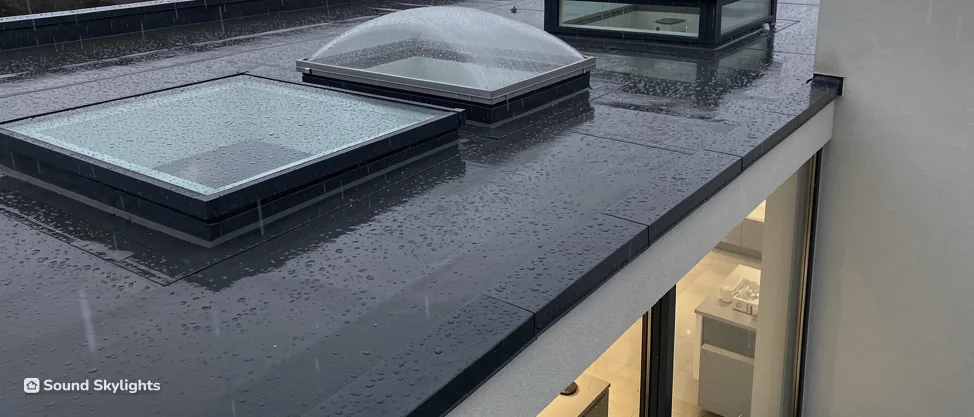
The best rooflight for a flat roof is the one somebody can live with on an ordinary Tuesday. A catalogue lists glass, frames and sizes. Daily life asks different things: who reaches the vent, how the outside pane gets clean, what happens when the afternoon sun lands on the table. Start from those and the choice among fixed, hinged, sliding, electric and dome units becomes much shorter.
Everything here is about rooflights on a flat or low-pitched roof, the kind set on a raised upstand over an extension, a back addition or a utility room. If you are weighing a raised, multi-sided lantern, read roof lanterns instead, and for the whole picture of fitting one, including what a survey covers, start at flat roof rooflights.
Begin with the person who opens it
Before looking at any unit, picture the household. Who will be standing under the rooflight when the kitchen fills with steam? Is that person tall, short, carrying a pan? Does anyone in the house find a raised arm difficult? Is there a child who treats every handle as a toy? These questions sort the types faster than any price list.
The answers sort into three groups. Some households want nothing to operate, and for them a fixed unit is the plain choice. Some want a vent they can work by hand, which points to a hinged unit and a control rod. Others want a switch or a handset, which points to electric opening, an option some makers offer on their flat rooflights. Sliding units and domes sit across those groups depending on the range.
Ceiling height matters as much as the people. Under a low extension ceiling a rod is within easy reach. Under a tall ceiling, or above a worktop where nobody wants to lean across a hob, a motor is kinder. We ask all of this before suggesting a unit, because the same glass can be a pleasure in one kitchen and a chore in the next.
A rooflight nobody can reach, wash or shade soon becomes the room's one regret.
Fixed glass: the unit that asks for nothing
A fixed flat rooflight is a sealed glass unit on its upstand. It does not open, so it has no hinge, no seal that moves and no handle. For a room where daylight is the whole point, such as a dining area, a corridor between the old house and a new extension or a home office, it can be all that is needed.
Living with one is easy to describe. You do nothing except shade it. If the room gets stuffy, you open a door or a window somewhere else in the house instead. That is a real trade: a fixed rooflight cannot vent hot air from a kitchen the way an opening one can, so it is worth asking whether the room already has a way to ventilate before ruling opening units out.
A fixed unit has a clean look from inside, because there is no vent line across the glass. Some makers offer a frameless-looking version, with little or no frame showing from inside. That depends on the maker's own range, and we name the models that carry which finish when we visit.
Hinged and sliding units: opening by hand
A hinged flat rooflight has a vent that lifts on one edge. It is opened with a control rod, a pole ending in a hook that engages a fitting on the frame, or with a small catch within reach. Rooms with a low ceiling suit it. The cost to a household is a thing to hang on the wall and a habit of using it.
A sliding unit is a different idea. A glazed panel moves across a fixed panel, giving a wide gap rather than a tilted one. Some makers offer sliding flat rooflights, and in the right room they give a good deal of air and an open feel. The points to check are where the moving panel sits when open, how the runner stays clear and how the weather seal closes, and each of those is the maker's detail for the model chosen.
For a child-safe house, think about where the rod lives. Hanging it out of reach keeps a hinged vent in adult hands. If that sounds like one thing too many to manage, the choice moves toward a fixed unit with a window elsewhere for air.
Questions for a hand-operated unit
- Where will the control rod hang, and who can reach it?
- Is the ceiling low enough for the rod to reach the catch?
- Does the opened vent clear the blind and the light fitting below?
- Who closes it when rain is forecast?
Electric and solar opening: a switch instead of a rod
Electric opening replaces the rod with a motor. The vent is opened and closed from a wall switch or from a handheld control. In a tall room, over a worktop or in a house where an older relative lives, that is simply easier. A solar-powered motor is a maker's option on some models and needs no cable run to the unit; whether it suits a particular rooflight depends on the model and the light it receives.
Rain is the thing people ask about. On some makers' electric flat rooflights a rain sensor is offered, closing the vent as the first drops land. It belongs to the models that have it, not to electric opening in general, so ask which units do before assuming it.
Wiring is the planning point. An electric vent needs a power feed and a switch position, and both are far easier to settle before the ceiling is finished. Our page on electric opening rooflights covers the controls in more depth, and the notes on rain sensors are in how rooflight rain sensors work.
Domes: when a plainer unit is the right one
A dome is a bubble of clear plastic, such as polycarbonate or acrylic, on a kerb. It is lighter in construction than a glass unit and plainer to look at from inside. It suits garages, outbuildings and utility spaces, and sometimes a corridor, where the aim is plain daylight and a picture-perfect finish is not.
On a dome, the surface is plastic, which the maker's instructions say how to clean. It is not walk-on. A dome can be fixed, or carry a vent where the maker provides one.
Where a room is lived in daily, such as a kitchen or a dining area, glass can be the better fit because of how it looks from underneath. That is a matter of taste as much as performance, and a dome can be a perfectly sound answer where the room is working rather than showpiece. If the roof is a garage or a studio roof at the bottom of the garden, ask about a dome first.
Who washes the outside pane?
A centre-pivot roof window on a pitched roof can be turned until its outer pane is inside the room. A flat rooflight cannot do that. Its outside face is cleaned from outside, with a long pole that feeds water to a brush head, or from the top of a ladder propped at the edge of the roof. Nobody needs to walk on the glass, and nobody should: standing on a rooflight is only for units built as walk-on.
That matters for the choice. A rooflight near the edge of a single-storey extension roof can be reached from the garden. One over a two-storey back addition, or set well back from the roof edge, is harder, and the cleaning routine becomes part of the decision. If nobody wants a ladder, think about whether a smaller unit near the edge is better than a large one in the middle.
Some outer panes carry a self-cleaning or easy-clean coating. That is the maker's own feature, on the units that have it, and it cuts the washing rather than ending it. The way to clean each unit is explained before we leave.
Shading the room by what it is for
A flat rooflight lets the sun in from above, which is wonderful at breakfast and tiring at two o'clock when it falls across a laptop. Every type needs a plan for shade, and the plan depends on the room.
Blinds suit this well. A blackout blind suits a bedroom or a playroom where a nap is wanted, a softer pleated blind a kitchen or an office, and a blind made for damp rooms a bathroom. Order the blind after choosing the unit, since it is cut to that unit's size code and make. Some makers offer motorised blinds for high ceilings, and on some ranges they run from the vent's own handset.
Glass can help as well. Some makers offer solar control coatings that cut the sun's heat. These are options on certain units, and we name the ones that carry them on the visit. Which way the room faces is worth noting down: an extension that catches long afternoon sun benefits from a different glass and blind than one facing the road.
| Type | Who opens it | Cleaned how | Shading |
|---|---|---|---|
| Fixed glass | Nobody | Pole or ladder | Pleated or blackout blind |
| Hinged | Anyone, by rod | Pole or ladder | Blind sized to the unit |
| Electric | Switch or handset | Pole or ladder | Motorised blind possible |
| Sliding | By hand or motor | Pole or ladder | Blind, maker permitting |
| Dome | Fixed, or a small vent | Per the maker | Per the maker |
Putting it together, and what happens next
With the household described, the choice can narrow to a short list. A kitchen with a high ceiling and a keen cook points to a motor-opened glass unit. A utility room with a low ceiling points to a hinged or fixed unit. A corridor wants a long fixed strip. A garage-studio wants a dome. Nothing here is a rule; it is the starting list for the visit.
Surveying costs nothing and happens ahead of any price. We study the roof, the joists, the covering and the upstand, and ask about the room: who is in it, who will open the vent, who will clean it. To begin before the visit, WhatsApp 07880 284133 with a picture of the room and the roof. The figure waits for the survey, then the fixed written quote follows for the unit you chose.
At handover, the controls, the cleaning routine and the blind choices are explained in the room itself. The planning side is covered in flat roof skylight planning permission, the upstand in flat rooflight upstands and coverings, and what moves the price in flat roof skylight cost.
From choice to handover
- Free survey. Roof, room and household are all examined.
- Options. The units that suit, with the opening and glass choices for each.
- Fixed written quote. Set out once the survey is done.
- Fitting. Opening cut, upstand set, unit fitted, covering tied in, ceiling finished.
- Handover. Controls, blinds and cleaning explained, and your written 10-year workmanship guarantee for the work.
Want this looked at on your own roof?
- Fixed written quote
- We handle the Building Regulations notification where the work is notifiable
- 10-year workmanship guarantee